
April 9, 2026
|
5
minute read
Why product discovery is your most expensive data problem




Many retail brands today are sitting on more customer data than they know what to do with. Transaction records, browsing behaviour, search queries, loyalty activity, return histories. And yet, product discovery is often still generic.
A first-time visitor and a customer who has spent $5,000 over three years will typically see the same homepage hero, the same bestsellers carousel, and the same category sort order.
The brands experiencing success are figuring out how to connect their existing customer data to the surfaces where shoppers make decisions, to create unique, targeted, and personalised experiences.
Here's what that looks like in practice.
The gap between data collection and discovery intelligence
There's a persistent assumption in ecommerce that more data automatically produces better experiences. However, data only creates value when it's unified, interpreted, and activated at the moment it matters. For product discovery, this is the second a shopper lands on your site, runs a search, or scrolls through a category.
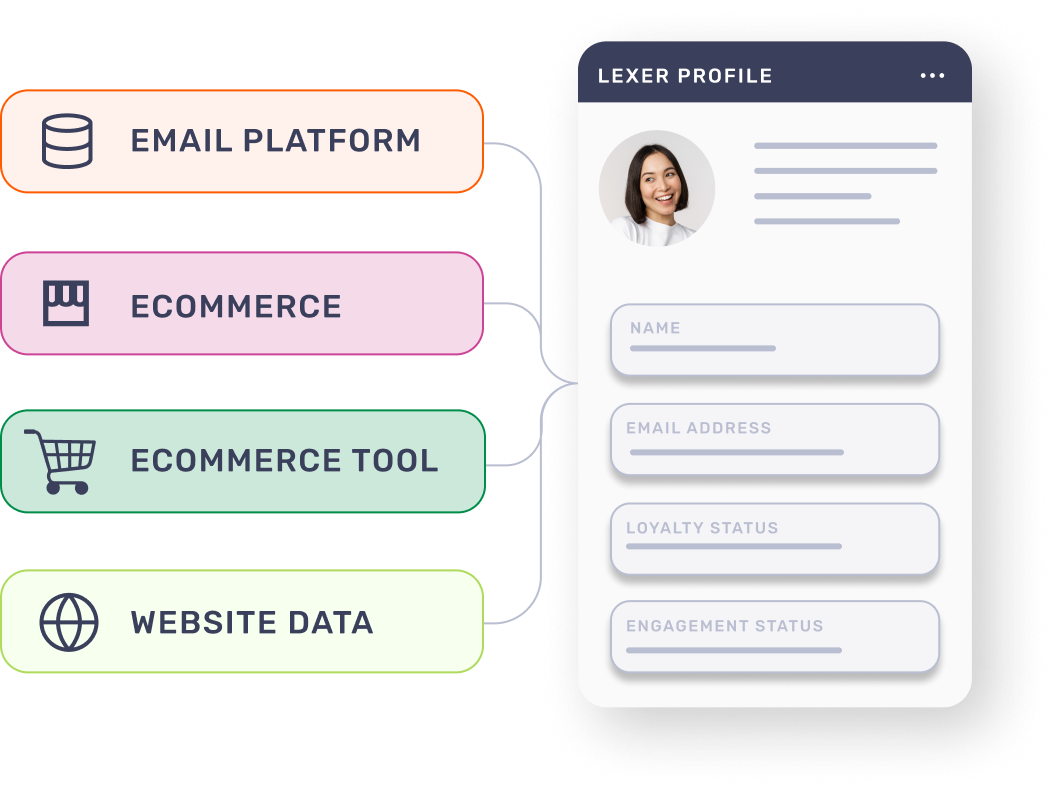
Unfortunately, those signals live in disconnected systems. Your email platform knows a customer clicked on a new-season workwear campaign three times. Your POS knows she's bought exclusively in that category for two years. Your ecommerce platform knows she searches by occasion rather than product type. None of these systems talk to each other, so your discovery layer treats her like a stranger every time.
Unifying these signals into coherent customer profiles is the step that separates smart discovery from generic browsing.
What your customer data actually reveals
Not all customer data is equally useful for shaping product discovery. The signals that matter most are those that reveal intent: what a shopper is in market for, when, and at what price point.
- Purchase history is the most reliable signal you have. A customer's category preferences, average order value, and purchase frequency tell you more about what they're likely to buy next than almost any other input. A shopper who buys regularly in a single category, at consistent price points, should see that category surfaced prominently.
- Behavioural engagement fills in the gaps transactions leave behind. Browsing patterns, search terms, wishlist additions, and time spent on specific product pages reveal consideration that never converted. A customer who views outerwear repeatedly without buying may be in a longer decision cycle, or they haven't seen the right option yet.
- Segment-level patterns are where discovery gets genuinely intelligent. When you can find that a particular cohort shares a strong preference for sustainable materials, occasion-driven buying, or premium price brackets, you can adjust discovery logic for that segment without needing individual-level data on every shopper.
This is what Alembika, a luxury women's fashion brand, discovered when they started working with Lexer. Their team had strong intuitions about who their customer was, but those intuitions were shaped by the noisiest voices, not the data. Lexer surfaced a customer segment they'd been overlooking entirely, one with significantly higher purchase intent. The result: an 8% increase in average order value and 11% revenue growth.
- Return and discount behaviour matters more than most brands account for. A customer who consistently returns items in a specific category, or who only buys during promotions, is telling you something important about the gap between what they're discovering and what they actually want.
Discovery is a margin problem, not just a conversion problem
Product discovery is a margin problem as much as a conversion problem. When discovery surfaces the wrong products, a few things happen. Conversion rates drop, return rates climb, and customers who had to work hard to find what they wanted are less likely to come back.
When discovery surfaces the products that genuinely match what a customer came looking for at a price point they've historically been comfortable with, in the category where they have clear affinity, the economics look completely different.
THE UPSIDE is a good example. By deploying Lexer's clienteling tool in their flagship stores and connecting customer data to in-store discovery, THE UPSIDE achieved a 75% conversion rate and a 13% increase in average order value.
The repeat purchase equation shifts too. Compana Pet Brands, working across three DTC brands, used customer insight to lift customer lifetime value by 14% and reduce one-time buyers by 22%. What that number represents, practically, is customers who found what they came for, and came back.
The 80/20 principle is well established in retail: a small proportion of customers generates a disproportionate share of revenue and margin. Across the Lexer client base, we consistently see this play out. In some brands, 20% of customers account for over 80% of total revenue. For those customers, discovery friction is particularly costly. A high-value customer who can't find what they came for doesn't fill out a support ticket. They leave, and they're expensive to win back.
Four ways to connect customer data to discovery
%20(1).png)
1. Segment your catalogue, not just your customers
Most segmentation thinking focuses on customers. Equally important is understanding which products over-index with which segments. When you know that a particular category drives repeat purchase from your most valuable cohort, that category deserves discovery priority for customers who match that profile, regardless of overall site popularity.
Mountain Khakis put this into practice when they found themselves with $600,000 of unexpected excess inventory and no dedicated budget to shift it. Rather than lead with discounting or a generic campaign, they went to the data first, segmenting by customer attributes before touching creative. The campaign generated a 150% revenue increase over the prior quarter, a ROAS of 4.64 vs 3.7, and shifted 95% of the specific returned stock.
As their Digital Marketing Manager put it: most marketers start with messaging, then seek out data to confirm it. Starting with the data first is what made the difference.
2. Let purchase cycles inform timing
Different customers buy on different cycles. A shopper who buys seasonally needs different discovery logic in October than in January. A customer with a tight replenishment cycle for basics needs different treatment than one who buys opportunistically. Discovery that adapts to purchase cycle timing converts at materially higher rates than one that treats the calendar as uniform.
3. Use engagement signals to surface latent demand
Customers who browse repeatedly without purchasing are communicating something: the right product hasn't appeared yet, or the right context hasn't been created. Connecting engagement data to discovery surfaces converts latent interest into purchase, without needing a customer to tell you what they want.
4. Build feedback loops from outcomes back into logic
Discovery should learn from its own results. Products that generate high return rates from specific segments, or that consistently underperform in particular categories, should inform future discovery logic. Without closing this loop, discovery optimisation is running blind.
Compana Pet Brands' VP of Digital & Ecommerce put it well: Lexer helped them find a low retention rate they hadn't spotted, put resources behind fixing it, and track the results in the same tool. That kind of closed loop, from outcome back to insight, is what makes discovery genuinely smarter over time.
The infrastructure question
None of this works if customer data and product discovery operate as separate systems with no shared intelligence.
The ecommerce brands that get this right have built or adopted infrastructure that connects unified customer profiles to the discovery and merchandising layer in real time. That means customer data flowing into discovery logic continuously, and segment membership updating as behaviour changes, so a newly high-value customer immediately receives discovery treatment that reflects their value.
The bottom line
Product discovery has historically been treated as a merchandising and UX challenge. Today, we’re seeing that the brands pulling ahead are those who are treating it as a data challenge and realising that the customer intelligence they already hold is the most powerful merchandising tool available to them.