
GUIDES
Customer data platform features: what retailers actually need
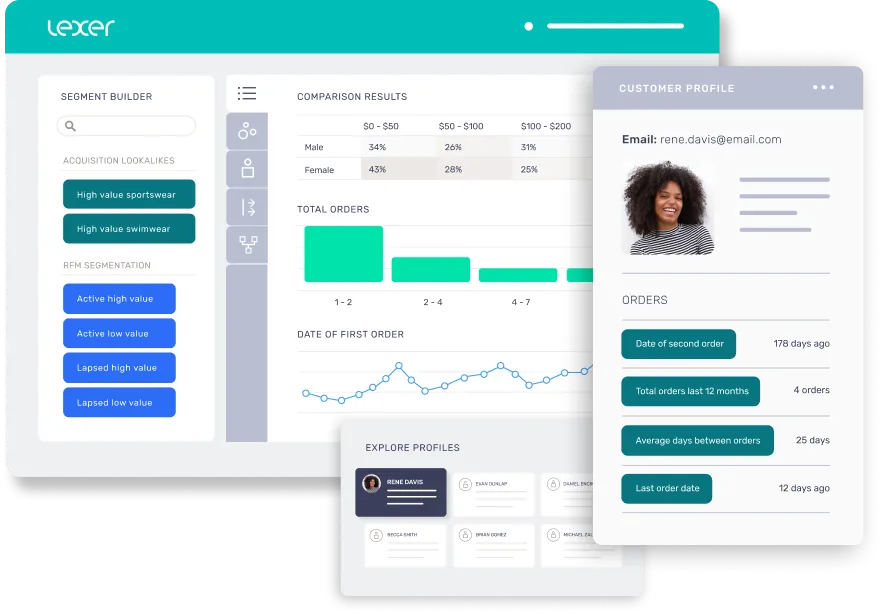
A customer data platform (CDP) ingests, unifies, and cleans data taken from various sources – such as social media channels, paid advertising and mobile devices – by removing duplicates. CDPs are used to control the flow of data between marketing systems and manage consent, and activate customer data that can be used across marketing platforms and channels. The features that matter most in a retail customer data platform (CDP) are identity resolution across online and offline, point of sale ingestion, product and margin data, self-serve segmentation, predictive scoring, two-way activation, governance, and enrichment. Everything else is a variation on those eight.
The eight that matter
1. Identity resolution across online and offline
Identity resolution is the single hardest thing a retail CDP does, and the one that determines whether everything else works. Deterministic matching on email and loyalty number is the easy part. The real test is whether the platform can attach in-store transactions to known customers when the receipt carries no email address. When evaluating CDPs, ask vendors what share of POS transactions they typically match for a retailer of your size.
2. Point of sale and in-store ingestion
This is whether the platform can read your POS, in the shape your POS produces, at the frequency that you need. Plenty of platforms that market to retail were built for ecommerce and treat in-store as a flat file import, which can rupture the real-time status of your unified data and contribute to partial profiles.
3. Product and margin data
Most CDPs ingest a transaction as a customer, a date and a value, which is enough to rank customers by spend but not much more. To see gross margin per customer, discount dependency or sell-through by segment, the platform needs product cost and the product hierarchy alongside the order.
4. Segmentation a marketer can run alone
If building a segment needs SQL, the platform has moved the bottleneck rather than removed it. Test this directly in a demo: ask someone non-technical from your team to build a segment unassisted.
5. Predictive scoring
Churn risk, purchase propensity, predicted lifetime value, next best category. These are only trustworthy when they're trained on complete omnichannel history, which loops back to feature one. Ask what the model actually uses and how often it retrains as a propensity score built on website behaviour alone will mislead an omnichannel retailer.
6. Two-way activation
A segment is worth nothing until it reaches the tool that sends the message. Look for native connections to your email and SMS platform, your ad platforms and your POS or clienteling app, and check that results flow back. One-way activation means you can send but never learn what worked.
7. Governance, permissions and audit
Who can see what, who approved which action, and can you reverse it. This matters more every year, and it matters immediately if any AI is touching customer data.
8. Enrichment
Third-party demographic, lifestyle and life-stage data appended to profiles, which are especially useful for acquisition and for understanding the customers you have. It's a good idea to check whether it's native or another contract to negotiate.
Three that sound important and usually aren't
- Real-time everything. Genuinely useful for abandoned cart and a handful of triggered journeys. For segmentation, reporting and audience building, hourly is indistinguishable from instant, and real-time ingestion adds cost and complexity you may never notice the benefit of.
- Native email sending. If you already run Klaviyo or Emarsys, a CDP that also sends email is offering to replace a tool your team likes.
- A chat interface with no data layer underneath. Plenty of tools have added a chat box. If it sits on top of unresolved, un-costed data, it produces fast confident answers that are wrong, which is worse than no answer.
How the main categories compare
- Enterprise CDPs (Segment, Tealium, mParticle, Amperity) are strongest on identity and scale, weakest on retail specificity. Expect 12 to 18 months and a data team.
- Marketing automation platforms (Klaviyo, Emarsys, Bloomreach, Attentive) are strongest on activation, weakest on unification and margin. They know what you sent, not what the customer is worth.
- Ecommerce analytics tools (Triple Whale, Polar) are strongest on campaign attribution, weakest on customer identity. Pixel-based, so they see sessions rather than people.
- Business intelligence tools (Looker, Tableau) answer questions you already know to ask, and can't push an audience anywhere.
How to pressure-test a feature list in a demo
Five questions that separate demonstrations from products.
- Show me a customer who bought in store and online, and show me where each record came from.
- Show me gross margin for a segment, and show me where the cost data comes from.
- Have someone on my team build a segment while we watch.
- Push that segment to our email platform now.
- Show me the audit trail for what you just did.
Anything that needs to be taken away and prepared is a roadmap item. Schedule a call and run the five questions above: Book a demo today.
Where Lexi fits
Lexi is built for omnichannel retail. The product ingests transactions, inventory, POS, loyalty, reviews and signals, resolves identity across all of them, and holds product cost alongside the order so margin per customer is available from the start. A semantic layer teaches Lexi what your data means in your business: what counts as a full-price buyer, which categories are seasonal, where the line sits between a prospect and a VIP.
Then you ask it a question in plain language. Lexi builds the answer, shows its working, builds the segment and activates it. Small reversible actions proceed on their own. Larger ones wait for a person to approve them.
Every figure traces back to a real calculation and every action is logged, permissioned and reversible.
A short checklist
Take this into vendor conversations.
- Can it read our POS, in our format, at our volume?
- What share of in-store transactions will it match to a known customer?
- Does it hold product cost, or only order value?
- Can a marketer build a segment without help?
- Does activation run both ways with our sending tools?
- Is enrichment native or a separate contract?
- Can we see who did what, and undo it?
- What is live today, and what is on the roadmap?
Related Articles
📄 Customer Data Platform (CDP)
📄 Customer Data Platform Architecture
📄 Customer Intelligence Platform
📄 Retail Data Customer Platform
📄 Customer Experience in Retail