
GUIDES
Data driven personalization in retail
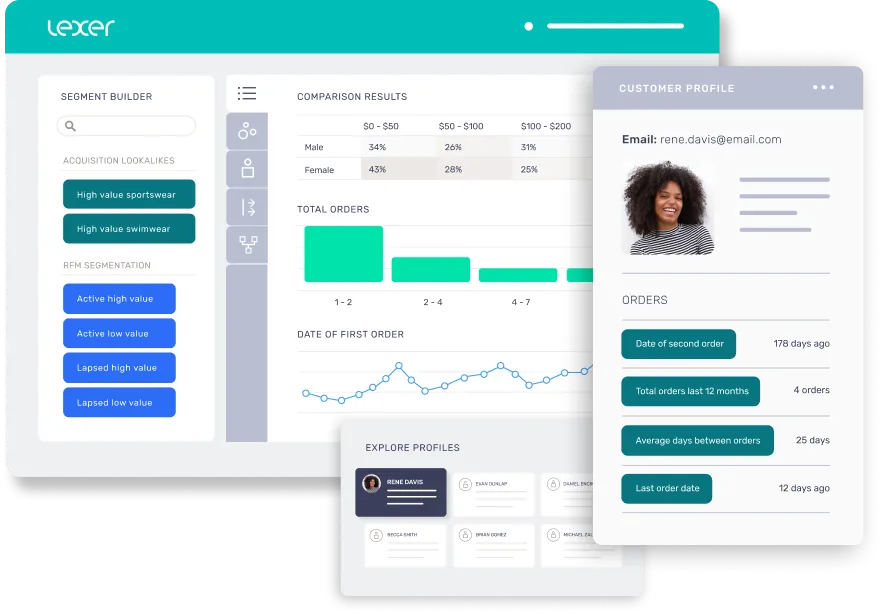
Data-driven personalization means changing what a customer sees, receives or is offered based on what you know about them, rather than on which broad group somebody assigned them to. In retail that covers product recommendations, message timing, offer selection, channel choice and in-store service, and its accuracy depends entirely on how complete the underlying customer record is.
The tactics are well documented and largely agreed on. What separates programs that work from programs that don't is almost always the inputs.
What it actually requires
Three inputs carry most of the weight, and a retailer missing any of them will find the tactics underperform regardless of how well they're executed.
The first is one record per customer, spanning online and in-store behavior. Personalization built on a partial history is personalization built on a partial person, and the failure mode is unpleasant rather than neutral: recommending a product someone bought in a store last week reads as carelessness rather than as a near miss.
The second is product and category structure with cost attached. Without it a recommendation engine optimizes toward what converts, which is reliably the discounted item, and the program improves conversion while eroding margin.
The third is each customer's own purchase cycle. Timing is most of personalization in retail, and a fixed thirty-day rule applied across a catalog containing both consumables and furniture will be wrong in both directions simultaneously.
The tactics that repay the effort
Product recommendations based on category affinity and purchase sequence work well, particularly when they draw on what a customer's nearest behavioral neighbors bought next rather than on what's popular overall.
Timing personalization is undervalued relative to how much it returns. Sending against each customer's own purchase cycle rather than a campaign calendar is often a larger improvement than anything done to the creative, and it costs nothing beyond knowing the cycle.
Offer personalization, which mostly means deciding who doesn't need a discount, is the tactic with the clearest margin impact. A meaningful share of any retailer's promotional spend goes to customers who would have bought anyway, and finding them is straightforward once margin data is attached to the customer record.
Channel personalization matters more than it's given credit for, since some customers respond to SMS and find email invisible while others are the reverse, and the data to tell them apart is usually already sitting in the sending tool.
In-store personalization is the hardest and the most differentiating, because it requires the store team to see the online history at the point of service, which requires the identity work to have been done first.
Where programs stall
The most common failure is personalizing everything. A retailer builds forty variants, none of them meaningfully different, and spends the year maintaining them for a result indistinguishable from the control. Personalization has a cost per variant, and past a certain point the cost exceeds the lift.
The second is personalizing on stated preference rather than observed behavior. What customers say they want in a survey and what they buy diverge regularly, and behavior is the more reliable signal by a wide margin.
The third is treating personalization as a channel problem. A program running only in email is personalizing one touchpoint while the website, the store and the advertising all continue to treat the customer as anonymous, which produces an inconsistency customers notice.
And the fourth, quietly, is never measuring against a holdout. Personalization programs are unusually good at claiming revenue that would have arrived anyway, and without a control group there's no way to know which part of the lift is real.
Consent, and the line customers notice
Personalization has a range within which it reads as useful and beyond which it reads as surveillance, and the line moves depending on how obviously the data was volunteered.
Customers are comfortable with a retailer using what they bought, because they were there when it happened. They're broadly comfortable with stated preferences, sizes and loyalty history for the same reason. Where it turns is when the personalization reveals something the customer didn't realize was being tracked, or joins two things they thought were separate. Referencing an in-store purchase in an email is the classic example: entirely legitimate, entirely legal with consent in place, and still capable of unsettling someone who hadn't connected their loyalty card to their inbox.
The practical guidance is to personalize on what the customer would expect you to know, and to be visibly useful when using anything beyond that. A recommendation that helps earns the data it used. One that only demonstrates how much you hold does not.
Operationally, consent needs tracking per channel rather than as a single flag, since email permission and SMS permission are different grants and are treated as such by regulators in Australia, the United States and Europe. It also needs to survive the customer record being unified, which is a common failure point: merging three profiles into one raises an immediate question about which consent state applies, and the safe answer is the most restrictive one.
Measuring it honestly
Hold out a randomized group and leave them out of the program entirely. The discipline is uncomfortable because it means deliberately not personalizing for a slice of the base, and it's the only method that produces a number anyone should act on.
Measure incremental gross margin rather than incremental revenue, since a personalization program that lifts revenue through better discounting has moved money around rather than made any. Then measure repeat purchase rate and time to second purchase for the treated group against the holdout, because the real return on personalization is usually a retention effect rather than a conversion one, and it shows up over months rather than weeks.
Where Lexi fits
Lexi supplies the three inputs that personalization depends on, and leaves the execution in the tools your team already runs.
Lexi ingests transactions, inventory, POS, loyalty, reviews and signals, resolves identity across every touchpoint, and holds product cost alongside the order. That gives a personalization program the full behavioral picture including in-store, each customer's own purchase cycle rather than a calendar rule, and margin as the thing to optimize toward.
You describe the audience you want in plain language and Lexi builds it, shows the logic, then pushes it into your sending platform. A chief executive at an athleisure brand described the problem precisely before starting: the team could talk to customers in fifteen different ways and could only ever build one message.
Lexi runs inside AWS Bedrock, data never leaves the platform, no personally identifiable information enters AI processing, and Lexer is SOC 2 certified.
A realistic first program
Pick one tactic and one segment. Timing against purchase cycle for lapsing customers is a good opening choice, because it needs no creative work, the data requirement is modest, and the effect is measurable inside a quarter.
Run it against a holdout, measure incremental margin, and only then decide whether to add a second tactic. Retailers who build the full program before measuring the first piece of it rarely find out which part was working.
Related Articles
📄 Customer Data Platform (CDP)
📄 Digital Transformation in Retail
📄 Customer Intelligence Platform
📄 Omnichannel Customer Experience
📄 Customer Data Platform Architecture
📄 Customer Segmentation in Retail
📄 Customer Experience in Retail