
February 20, 2026
|
7
minute read
Getting started with personalisation: a retailer’s guide to delivering personalised experiences




Data-rich, but insight poor
Personalisation has become a key strategic pillar in retail marketing. Although not a new concept, the rapid development and integration of AI tools has allowed retailers to experiment with more complex hyper-personalisation, largely with incredible results. Retailers that aren’t incorporating personalisation to the same degree are fast becoming left behind.
McKinsey research found that faster-growing companies are attributing 40% more of their revenue to personalisation when compared with their “slower-growing counterparts”. We also know that increasing numbers of shoppers expect product recommendations, and are actively disappointed when they don’t exist.
However, despite all of the evidence pointing towards the benefits of personalisation, many retailers aren’t actively investing in personalisation, or they are keeping it surface level.
Analysing the data we could find on the topic, both through qualitative and quantitative sources, revealed that the primary issue isn’t data collection. In fact, one study suggests that the average retailer collects 100+ data points per customer, and some collect up to 500. This is a remarkable amount of information, all of which should be leveraged for personalisation. We know that it’s no longer viable to build a personalisation strategy with minimal data points, e.g., “first name” + “last purchase date”.
But, if the majority of retailers are collecting 100+ data points about their customers, then what is preventing them from killing it at personalisation?
When data doesn’t lead to personalisation
The issue of silos
Although retailers are collecting data points, these are often coming from disparate and disconnected sources. Each one of these sources contains important information, but there is no communication pathway set up between the sources, leading to fragmentation.

Clean data is an unattainable myth
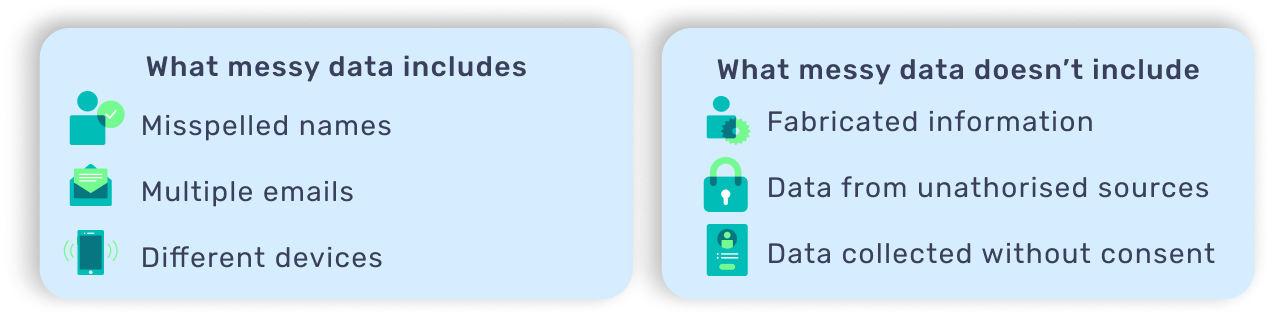
Another issue can be found in the pursuit of a perfectly clean dataset before they invest in personalisation. But most of the time, this level of perfection doesn’t exist and retailers are waiting for a future that won’t arrive. The best approach is to focus on consolidating usable data, and building a strategy around personalising despite messy data.
Analysis paralysis
The third and final reason is an experience every marketer faced with too much data has experienced – analysis paralysis. There are hundreds of data points to validate, analyse, and prioritise. You can spend months in the numbers, trying to understand all of the possible implications of customer behaviour. And then once this process is complete, the customer’s behaviour has changed and you have to scrap your analysis and start again.
Perfectionism won’t get you anywhere in an industry as fast-paced as retail.

What data do you need to start personalising?
Although collecting data is always better than not collecting data, it is 100% a case of quality over quantity. We’ve spent a lot of time looking at the types of data being collected by retailers and understanding what actually drives impact. When it comes to personalisation, there are three categories of data to be aware of: the essentials, the nice-to-haves, and the not necessary’s.
The essentials
Identity data
What is it?
- Email address
- Phone number
- Customer ID
Why does it matter? You can’t personalise if you can’t identify customers. This information is the foundation for your customer profiles.
Good enough threshold: One reliable identifier per customer.
Transaction data
What is it?
- Purchase history
- Average order value
- Purchase frequency
Why does it matter? Past behaviour predicts future behaviour. To build an effective strategy, you need predictive metrics.
Good enough threshold: The last 12 months of purchases, even if it is incomplete.
Engagement data
What is it?
- Email opens and clicks
- Website visits
- Product views
Why does it matter? These metrics demonstrate interest, even when customers don’t make purchases.
Good enough threshold: 60 days of recent activity
Preference data
What is it?
- Category affinity
- Price sensitivity
- Channel preference
Why does it matter? Allows you to identify relevant recommendations.
Good enough threshold: Signals from the last 3-6 purchases.
The nice-to-haves
- Demographic data: Age, location, gender (useful for segment-level insights, not individual personalisation)
- Lifecycle stage: New vs. repeat vs. loyal vs. lapsed (can be inferred from transaction data)
- Product reviews and ratings: What they think, not just what they bought
- Customer service history: Returns, complaints, support tickets
- Social engagement: Follows, likes, comments
The not necessaries
And then there are the data points that don’t specifically drive personalisation.
- Extensive browsing session data that goes beyond product views
- Granular demographic details
- Third-party lifestyle data before first-party data has been maximised
- Real-time location tracking. It’s important to always consider privacy concerns, which usually outweigh benefits when it comes to location tracking.
Personalisation with messy data
Perfect data doesn’t exist. So how do you create an effective personalisation strategy anyway?
Realistic identity resolution
You firstly need to solve for identity resolution that is good enough. Despite the instances of messy data (e.g., customers using different names for shopping vs. loyalty programs, misspelling their names, shopping as guests), you need to unify your customer information. To do so, incorporate probabilistic matching, not just deterministic. You should accept that an 85-90% match rate is the ballpark, and prioritise recent, reliable identifiers over historical messy ones.
Most helpfully, let your CDP handle the unclear matching so it is not a manual task for marketing.

Focus on behavioural signals
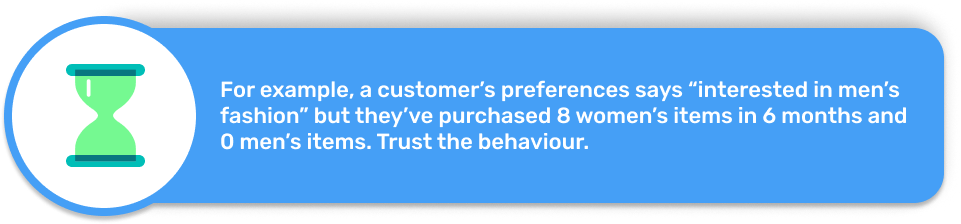
Behavioural signals are much more reliable data points for personalisation than declared data. You should prioritise what customers do more than what they say, and identify when changes occur. It’s important to look at recency; behaviours from the last 30 days will always beat declared preferences from 2 years ago.
Build robust segments that account for gaps
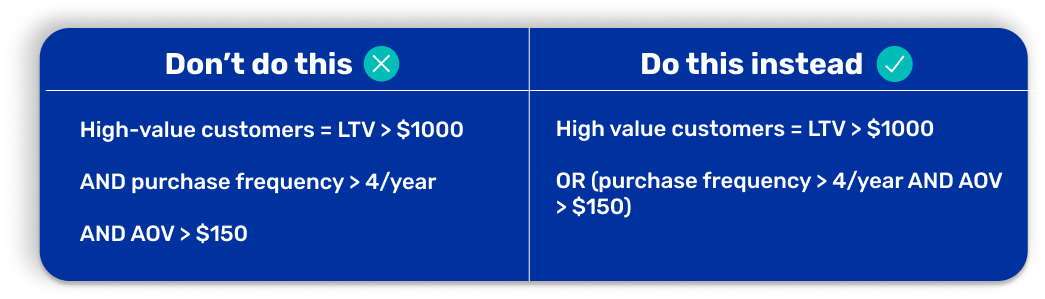
When building your segments, take into account the likelihood of data gaps and figure out how these might prevent customers from qualifying for segments. Personalisation won’t have any effect if your segments are empty, or not capturing the appropriate customers.
Where technology comes in
Personalisation in retail is much more likely to be successful with the right infrastructure in place. The scale of capturing over 100 data points per customer means that manual segmentation is extremely difficult. By the time data has been exported and cleaned, customer behaviour will have changed, and the insights are no longer useful. Further, manual identity resolution is pretty much impossible beyond a few hundred customers – especially if you are dealing with siloed sources and messy data points.
What a CDP does differently
Lexer has been built to solve for all of these messy data issues and enable personalisation for retailers. Here’s how it does that:
Automated identity resolution: Manages data matching, multiple identifies, and profile merging without manual intervention. Lexer matches different identifiers from various sources to create a Single Customer View.
Real-time profile updates: Customer profiles update as behaviour changes, so personalisation stays current even when the historical data is messy.
Flexible segmentation logic: Segments can be built that work with incomplete data using OR condition, probability thresholds, and predictive attributes.
Behavioural intelligence: Lexer prioritises recent actions over stale declared data. Retailers can optimise based on what a customer is doing now, allowing them to trigger messages based on recency factors rather than stale profile data.
Enrichment capabilities: Lexer fills gaps in first-party data with third-party enrichment when needed.
Personalisation in retail: A getting started checklist
To help, we've created a downloadable PDF checklist for getting started with personalisation. This step-by-step guide walks you through auditing your data, building your first segments, launching campaigns, and measuring results.
Progress over perfection!
The retailers winning at personalisation aren't the ones with the cleanest data, but the ones who stopped waiting for perfect and started personalising with what they have. Your customers don't know your data is messy. They only know whether your messages feel relevant or generic.
Start with what you have. Build three segments based on behavioral signals. Launch personalised campaigns and measure against your broadcast baseline. Prove that "good enough" personalisation with messy data dramatically outperforms generic messaging. Then invest in the infrastructure that scales what works.
Ready to turn your messy data into personalised experiences? Book a demo with Lexer.
FAQs
What data do I actually need to start personalising retail experiences?
- Identity data: Reliable unique identifiers like names, email ,or mobile numbers to link sessions.
- Transaction data: The "what, when, and how much" that defines your high-value segments.
- Engagement data: Metrics like email opens to better understand customer interests.
- Preference data: Patterns and trends in customer purchase behaviour.
What are some examples of personalisation platforms used by retailers?
The landscape generally splits into three categories:
- Customer Data Platforms (CDP): CDPs like Lexer unify data and provide the intelligence to drive strategy.
- Experience & storefront tools: Platforms like Athos focus on the on-site journey, optimising search and product grids.
- Omnichannel Eeecution: Platforms like dotdigital or Klaviyo handle the delivery of messages across email, SMS, and push notifications.
What is the ideal tech stack for a retailer to deliver real-time personalisation across web, email, and SMS simultaneously?
An ideal tech stack in 2026 typically follows an architecture similar to:
- The foundation: Shopify Plus for web and a cloud-based POS for physical stores
- The brain (CDP): Lexer to unify data, resolve identities, and create predictive segments
- The voice: A marketing automation tool to trigger SMS and email sequences