
GUIDES
AI CDP: what an AI customer data platform actually does
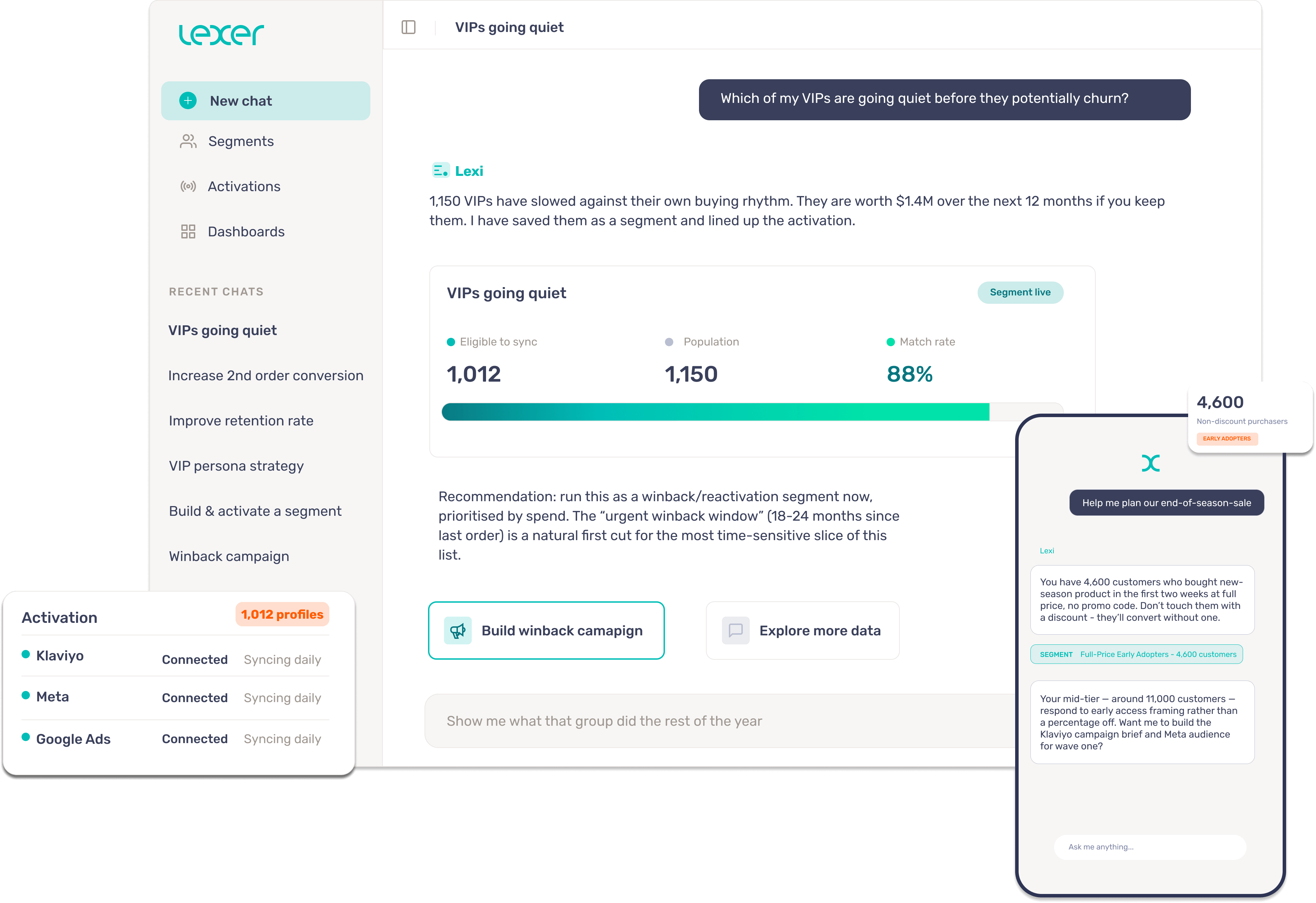
An AI customer data platform applies machine learning across the customer record to do things a rules-based platform can't: resolve identity where there's no exact match, predict what a customer is likely to do next, answer questions asked in ordinary language, and act on those answers within agreed limits. Those are four genuinely different capabilities, and vendors using the label rarely specify which of them they mean.
The four things called AI here
Matching came first and gets discussed least. Probabilistic identity resolution scores likely matches on combinations of name, address and card token in the many cases where an exact email match isn't available, and it quietly determines how accurate everything downstream turns out to be.
Prediction is the best established of the four. Churn risk, purchase propensity, predicted lifetime value, next best category: all useful, all well understood, and all entirely dependent on how complete the history behind them is.
Generation is what most people now mean when they say a platform has AI. A question asked in plain language becomes a query, and the query becomes an answer. It's the newest of the four and comfortably the best in a demo.
Agency is the one that changes a team's output rather than its reporting. The platform acts on the answer, building the segment, pushing it to a sending tool and watching what happens next.
Why AI on unresolved data is worse than no AI
This is the central risk in the category and it's worth being blunt about.
If the same customer exists three times over in your data, a model trained on it will conclude that your customers buy less often than they do. If product cost is missing, it will put your discount-dependent customers at the top of the value ranking. If in-store purchases never made it in, it will decide your best customers shop online only. None of those outputs looks wrong on the way past. They arrive with a confidence score attached and a clean chart underneath, which is precisely the problem: analysis that is obviously poor gets ignored, while analysis that presents well gets acted on.
Poor data quality is the most commonly cited blocker to getting value from AI in marketing, and the ordering here isn't a preference. Resolution comes before analysis, or the analysis is worth less than nothing.
How retail brands are using AI for customer segmentation
Four applications are in genuine use, in roughly descending order of maturity.
Automated segment discovery hands the job of defining groups to the model, which looks for customers behaving alike and surfaces clusters nobody thought to go looking for. It earns its place mostly by finding the group sitting awkwardly between two assumed personas.
Propensity-based segments define membership by predicted likelihood rather than by what has already happened, which is why a likely-to-churn segment is more useful than a lapsed one. The customer is still there.
Natural language segment building lets someone describe the audience they want and have the platform assemble it, and this is the change that actually removes the analyst queue, provided the resulting segment can be activated rather than only admired.
Continuous resegmentation keeps membership current as behaviour shifts, so a customer who starts to lapse moves groups without anyone rerunning anything.
What isn't yet common, whatever the marketing suggests, is fully autonomous campaign management. Every credible implementation keeps a person in the loop wherever the decision carries consequence.
What agentic means, and what it shouldn't
Agentic describes a platform that acts rather than only reports, and the version worth having is a bounded one.
Small reversible actions should proceed without asking: refreshing a segment, updating a score, flagging something that looks off. Anything larger waits for a person, whether that's a send to a substantial audience, a change to a definition, or a discount going out. Autonomy of that kind is earned on track record rather than switched on at setup.
The questions to put to a vendor are specific ones. Which actions happen without approval, who set that boundary and can you move it, is every action logged, and can any of them be reversed. Vague answers usually mean the product is a chat interface with ambitions.
The governance questions
Once AI is touching customer data, six questions stop being optional.
- Where does processing happen?
- Does your data leave the platform?
- Does personally identifiable information enter the model?
- Is anything you contribute used to train something other customers benefit from?
- Can every figure be traced back to a real calculation?
- Is there an audit trail, with actions that can be reversed?
Where Lexi fits
Lexi is the agentic customer data platform for omnichannel retail, and it covers all four of the capabilities above rather than one or two of them.
The foundation comes first, because it has to. Lexi ingests transactions, inventory, POS, loyalty, reviews and signals, resolves identity across every touchpoint, and holds product cost alongside the order. Sitting over that is a semantic layer carrying what your terms actually mean inside your business, so the difference between a full-price buyer and a discount-dependent one, or between a seasonal category and a core one, is something Lexi already knows rather than something you re-explain each time. That context is why the answers come back as retail answers rather than generic ones.
Then you ask. Lexi builds the answer from your data, shows its working, builds the segment and activates it into the tools your team already uses, with small reversible actions proceeding on their own and anything larger waiting for sign-off.
On governance, the answers to those five questions are that processing happens inside AWS Bedrock, data never leaves the platform, no personally identifiable information enters AI processing, every figure traces back to a real calculation, and every action is logged, permissioned and reversible. Lexer is SOC 2 certified.
Set against a general-purpose AI tool with a spreadsheet export, the difference isn't analytical horsepower. It's that a chat session can't resolve identity across POS, ecommerce and loyalty, can't push a segment anywhere, creates real privacy exposure the moment customer data is pasted into it, and disappears when the tab closes. Nothing accumulates.
How to evaluate an AI CDP
Six things, and all of them can be settled in a single session.
- Ask which of the four capabilities the product genuinely has, and have each one demonstrated rather than described.
- Ask what the models are trained on and how often they retrain.
- Ask what share of in-store transactions get matched to a known customer for a retailer your size.
- Follow one number in the answer back to the calculation that produced it.
- Have someone non-technical from your team ask it a question unaided.
- Ask for the list of actions it will take without approval.
Related Articles
📄 Customer Data Platform (CDP)
📄 Customer Loyalty and Retention Strategy
📄 Customer Intelligence Platform
📄 Customer Data Platform Architecture
📄 Customer Segmentation in Retail
Common questions
What is an AI CDP?
An AI customer data platform applies machine learning across the unified customer record to resolve identity probabilistically, predict behaviour such as churn and propensity, answer plain-language questions from the data, and take bounded action on the result. The four capabilities are distinct, and many products marketed this way offer only one or two.
How are retail brands using AI for customer segmentation?
Four applications are in real use: automated discovery of groups that behave alike, segments defined by predicted likelihood rather than past behaviour, building segments by describing them in plain language, and continuous resegmentation as behaviour changes. Fully autonomous campaign management remains rare, and credible implementations keep a person in the loop.
Is it safe to use AI with customer data?
It depends on the implementation. The questions that matter are whether processing happens inside the platform, whether personally identifiable information enters the model, whether your data trains anything shared, whether figures trace back to a real calculation, and whether actions are logged and reversible. Uploading customer data to a general-purpose AI tool creates genuine privacy exposure.
See how Lexi helps retailers drive more sales.
Leading retailers unify their customer data, build high-value audience segments, and grow lifetime value with Lexi.
Book a demo