
October 1, 2026
|
8
minute read
7 plays to maximise Black Friday profit: a BFCM playbook for mid-market retailers




Black Friday Cyber Monday (BFCM) can deliver your biggest revenue week of the year and still cost you money. The retailers who come out ahead plan against margin, protect the customers who would have paid full price, and judge the event by what it did to next year's customer file. This playbook breaks BFCM into seven plays across preparation, live trading and reporting, with the Lexi prompts to run at each stage.
BFCM keeps growing, which raises the stakes on getting it right. According to Adobe's 2025 holiday shopping data, US consumers spent US$44.2 billion online across Cyber Week, with Black Friday alone reaching US$11.8 billion, up 9.1% year on year. In Australia, the Australian Retailers Association and Roy Morgan forecast a record A$6.8 billion in spending over the 2025 Black Friday to Cyber Monday weekend, a 4% increase on the previous year.
Bigger revenue raises a harder question. Every discount you give a customer who would have paid full price is margin you never get back, and every promotion-only customer you acquire is a cost you carry into next year. The seven plays below help mid-market retail teams answer that question with their own customer data, before, during and after the event.
Before BFCM: preparation plays for Black Friday
Black Friday preparation should start eight to ten weeks out, with a margin-based audit of last year, a discount dependency segmentation and an offer plan tied to stock. Black Friday 2026 falls on 27 November and Cyber Monday on 30 November, so most teams reading this have around eight weeks to work with.
1. Audit last year's Black Friday in gross margin dollars
Start BFCM planning by measuring what last year's event earned in gross margin dollars, because revenue alone can make a loss-making weekend look like a win.
Gross margin dollars measure the money you kept after discounts and returns. A BFCM weekend that lifts revenue by a fifth while doubling the average discount can leave you with fewer margin dollars than an ordinary trading week. Comparing the event with the four weeks either side shows whether BFCM created new demand or pulled forward purchases that would have happened at full price.
The second half of the audit looks at who received the discount. Customers who bought at full price in the six weeks before BFCM and then bought again during the sale represent margin you gave away to people who were already willing to pay. Knowing the size of that group tells you how much a smarter offer structure is worth.
How to take action
Run these two prompts in Lexi. Both come from the Lexer Black Friday use case explorer:
What was our total revenue and gross margin across Black Friday and Cyber Monday last year, and how did margin compare with the four weeks either side?
How many customers who bought at full price in the six weeks before BFCM also bought during it, and what did that cost us in margin?
Record the answers as your baseline. Every decision in plays 2 to 4 gets measured against them.
Lexi calculates gross margin per customer from unified ecommerce, POS and loyalty data, so the audit covers in-store buyers as well as online ones, without a data analyst writing queries.
2. Segment customers by discount dependency before you set the offer
Discount dependency segmentation splits last year's buyers into customers who never buy on promotion, customers who occasionally do, and customers who only buy on promotion. The size of that last group tells you how much of your BFCM revenue you can trust.
A large promotion-only base means much of your headline number comes from customers who have learned to wait for a sale. A small promotion-only base means your offer is reaching customers who value the brand and simply picked a good moment to buy. Both readings change how aggressive your offer should be.
The same segmentation sets up suppression. Full-price loyalists are the customers most worth protecting from a sitewide code. Offering them early access or a gift with purchase recognises their loyalty while keeping them out of the percentage-off offer, which protects margin.
How to take action
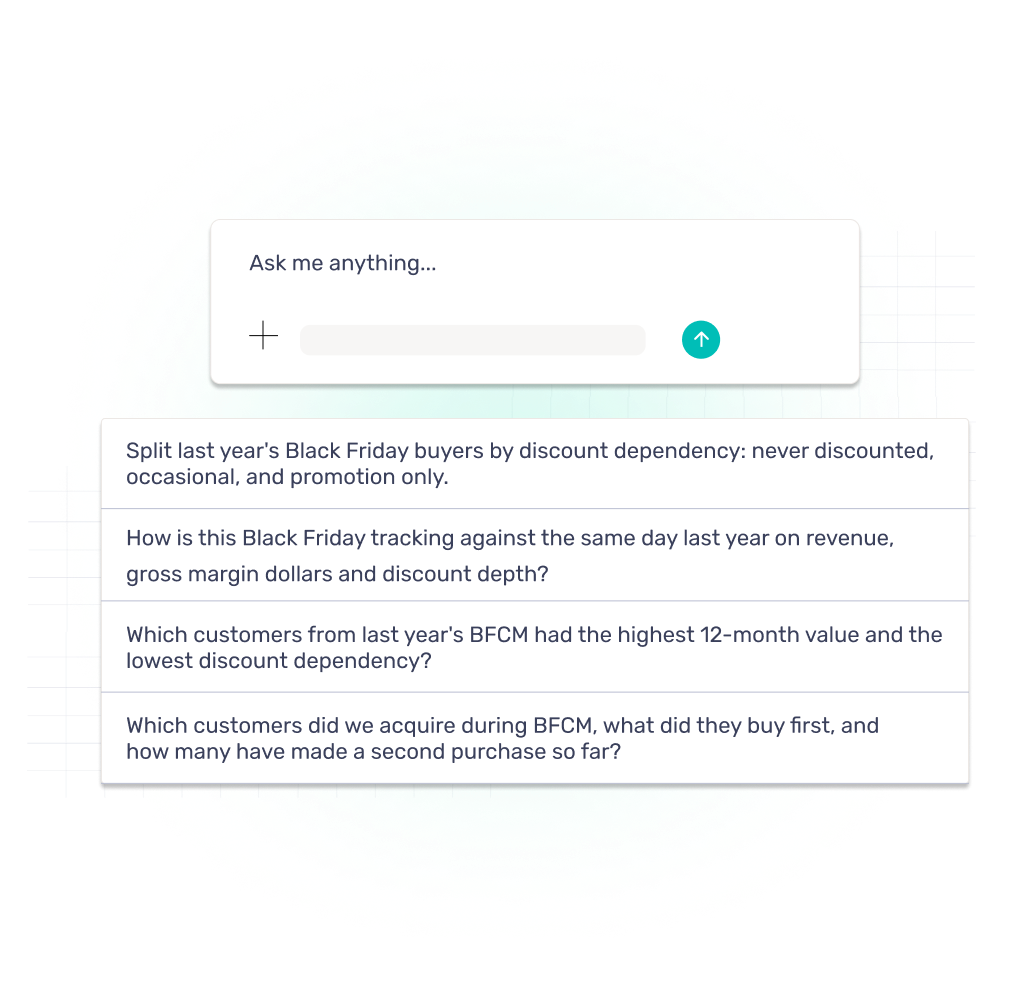
Split last year's Black Friday buyers by discount dependency: never discounted, occasional, and promotion only.
From the answer, build a suppression audience of full-price customers and send it to your email and SMS platform as an exclusion list. Keep a record of how many customers you suppressed and their average order value. You will need both numbers for the margin protected metric in play 6.
Lexi works as a customer segmentation platform, building the discount dependency segment and pushing it straight to Klaviyo, Meta or Google Ads, so the exclusion list goes live in the tools your team already uses.
3. Set your BFCM discount depth against a margin floor and stock position
The right BFCM discount is the shallowest offer that still hits your conversion target, set by category against your margin floor and current stock.
Deeper discounts rarely earn their cost. According to Klaviyo's BFCM 2024 results, discounts in the 10% to 15% and 20% to 25% ranges drove the highest conversion and spending across its brands, ahead of steeper price cuts. That gives mid-market retailers room to test lighter offers with more confidence.
Stock position matters as much as margin. Lines with strong full-price sell-through may not need to be in the sale at all, while slow-moving lines carrying excess inventory can justify a deeper offer. One flat sitewide discount ignores both signals and gives away margin on products that would have sold anyway.
Lead with the decision you need to make, and name your constraints up front. Lexi optimises against whatever you tell it, so include your margin floor, stock position and any blackout dates. For example:
I'm working out how deep to discount for Black Friday. Our margin floor is 45%. Which categories sold through at full price last November, and which carried excess stock into December?
Use the answer to sort your range into three tiers: hold at full price, light offer, and clearance. Then ask Lexi to show its logic before you commit budget to the plan.
4. Build BFCM acquisition audiences from your best customers and set a holdout
Seed your BFCM lookalike audiences with your highest-value, least discount-dependent customers, and set aside a holdout group before any campaign goes out so you can measure what the campaign actually drove.
Paid media costs peak during BFCM, and broad targeting fills your customer file with one-time deal seekers. Seeding Meta and Google lookalikes from customers with high lifetime value and low discount dependency points acquisition spend at shoppers who resemble your best buyers. The same discipline pays off on your own higher-cost channels. Global dance brand Bloch builds segments from customer behaviour, purchase history and RFM data, and for Black Friday used that approach to build a tightly targeted SMS audience. Bloch exported the segment to Klaviyo, and that single campaign returned a 6,000% ROI.
A holdout group is a random slice of your target audience that receives no campaign. Comparing the holdout's spend with the contacted group's spend separates incremental revenue from purchases that would have happened regardless. The holdout has to exist before you send. You cannot build one after the event.
How to take action
Which customers from last year's BFCM had the highest 12-month value and the lowest discount dependency? Build them into a seed audience for Meta lookalikes.
Hold back a random share of each owned-channel audience as a control, large enough that a difference in spend will be visible. Lexi sends the seed audience to Meta and Google Ads through its audience activation platform connections, so the audience refreshes as new customers qualify.
During BFCM: what to watch while Black Friday campaigns are live
While BFCM campaigns are live, your job is to catch margin problems early enough to fix them the same day.
5. Track Black Friday live against last year on margin, discount depth and customer mix
Monitor revenue, gross margin dollars and average discount depth against the same day last year while campaigns are live. When margin dollars fall behind while revenue climbs, tighten the offer.
Revenue dashboards update fastest and get the most attention on the day, which is exactly why margin problems slip through. An order spike driven by the most heavily discounted products, or a surge of promotion-only customers, shows up in margin and customer mix before it shows up in revenue. Competitive pressure adds to the risk. According to Adobe, apparel discounts peaked at 25% off list price on Cyber Monday 2025, and matching rivals mid-event is the fastest way to erase a carefully planned margin.
What to look out for
Agree intervention triggers with your finance and merchandising leads before the event, so decisions on the day take minutes. Useful triggers include:
- gross margin dollars tracking a set percentage behind last year by midday
- average discount depth climbing above your planned level
- customers from your full-price suppression list appearing in sale orders
- a hero product selling out while paid campaigns still point at it
How to take action
How is this Black Friday tracking against the same day last year on revenue, gross margin dollars and discount depth?
Run this at fixed checkpoints through the day, such as morning, midday and evening. If margin is behind, ask Lexi which categories are driving the gap, then adjust the offer or pull spend from the lowest-margin campaigns. Every Lexi answer ends with a suggested next move, so the question, the segment and the fix stay in one conversation.
After BFCM: how to report on Black Friday and plan the next order
After BFCM, report on profit and customer quality, then turn new customers into repeat buyers before next November.
6. Report on BFCM with six metrics that measure profit and customer quality
Six metrics tell you whether BFCM worked: gross margin dollars, margin protected by suppression, new customer quality at 90 days, full-price sell-through, incremental revenue against holdout, and promo drift.
t
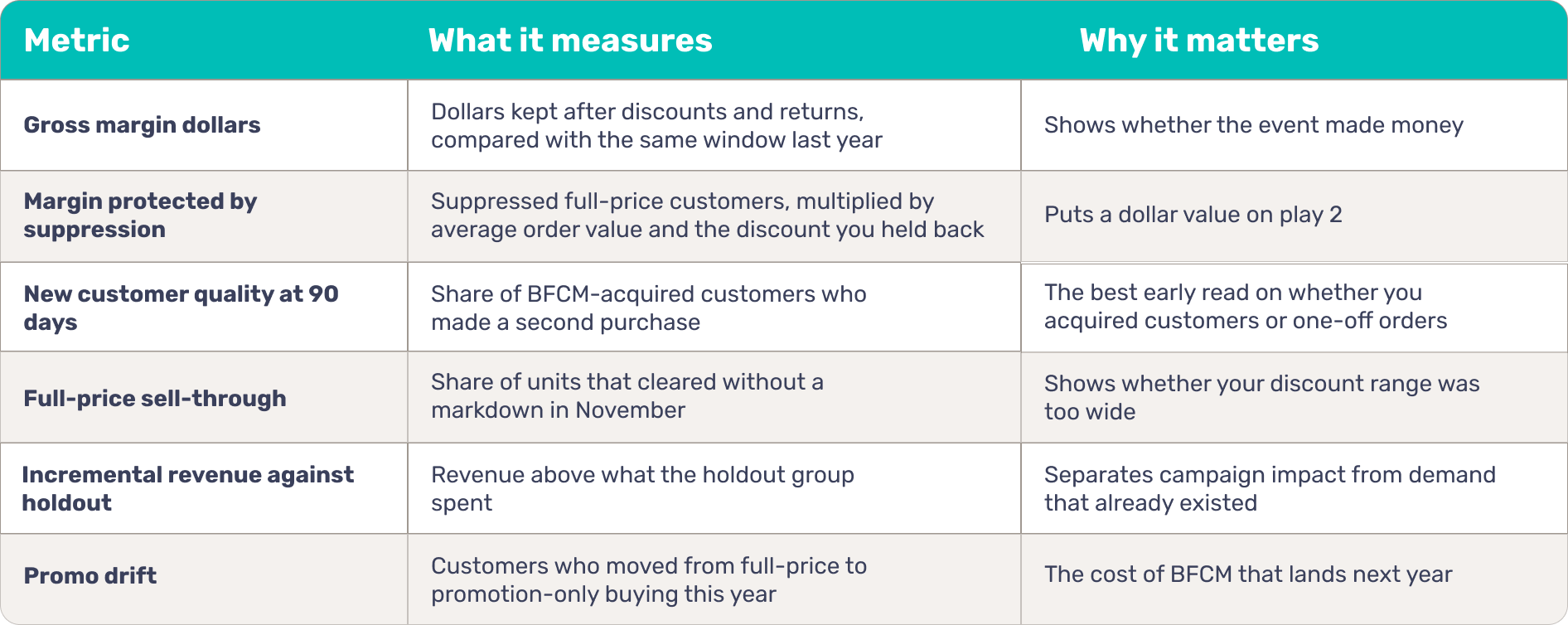
Revenue and return on ad spend still belong in the report. On their own, though, they reward the wrong behaviour. A campaign that lifts revenue by discounting your most loyal buyers looks strong in a revenue report and weak across these six measures.
How to take action
Note your baselines for all six metrics now, so you have something to compare against in January. Then run:
Compare this BFCM with last year across revenue, gross margin dollars, discount depth, new against returning, and return rate.
Share the results with finance and merchandising in the same meeting, so next year's offer strategy starts from the full picture. Lexi tracks KPIs by segment as a marketing reporting platform, so you can compare how promotion-only buyers performed against full-price loyalists.
7. Turn BFCM-acquired customers into repeat buyers before next November
The most valuable post-BFCM work is getting new customers to a second purchase quickly, because most Black Friday-acquired customers never buy again.
According to Ometria's analysis of Black Friday 2025, only 4% of customers first acquired on Black Friday 2024 made a repeat purchase within 12 months, and Black Friday-acquired customers were six times less likely to return than typical new customers. The dataset covers Ometria's retail client base across fashion, beauty, lifestyle and specialty retail, and it points to a clear gap for most brands.
Promotion-led customers need a reason to come back that has nothing to do with price. Segment your BFCM cohort by first product, acquisition channel and whether they used a code, then build onboarding journeys around product fit: care guides, complementary products and restock timing.
How to take action
Which customers did we acquire during BFCM, what did they buy first, and how many have made a second purchase so far?
Check the answer at 30, 60 and 90 days and adjust journeys for the cohorts that stall. As a customer retention platform, Lexi flags BFCM customers at risk of churning before they lapse, giving your team time to act while a second purchase is still likely.
Making your BFCM playbook work in 2026
A profitable Black Friday comes from decisions made weeks before the sale and measured months after it. Audit last year in margin dollars, segment by discount dependency, set offers against stock and a margin floor, and seed acquisition from your best customers with a holdout in place. Watch margin as closely as revenue while campaigns are live. Then report on the six metrics that show whether you grew the business, and give new customers a reason to buy again before next November.
The Lexer Black Friday use case explorer has 30 prompts across preparation, live trading and post-event reporting if you want to go further than the ones in this playbook.
Book a demo to see what Lexi can do with your Black Friday customer data.
Frequently asked questions
How should a mid-market retailer prepare for Black Friday?
Mid-market retailers should prepare for Black Friday by auditing last year's event in gross margin dollars, segmenting customers by discount dependency, and setting offer depth against a margin floor and current stock. Build acquisition audiences from high-value customers and set a holdout group before any campaign is sent. Starting eight to ten weeks out gives time to agree baselines, suppression lists and live-trading triggers with finance and merchandising.
How do I stop Black Friday discounts eroding my margin?
Protect Black Friday margin by suppressing full-price customers from sitewide offers, tiering discounts by product sell-through, and choosing the shallowest discount that meets your conversion target. According to Klaviyo's BFCM 2024 results, discounts of 10% to 15% and 20% to 25% drove the highest conversion and spending across its brands, ahead of steeper cuts. Track gross margin dollars against last year during the event so you can tighten offers the same day.
What metrics should retailers use to measure BFCM success?
Measure BFCM success with six metrics: gross margin dollars against last year, margin protected by suppressing full-price buyers, the share of new customers who purchase again within 90 days, full-price sell-through in November, incremental revenue against a holdout group, and promo drift, meaning customers who moved from full-price to promotion-only buying. Together they show whether the event created profit and healthy customers or simply pulled revenue forward.
What is discount dependency segmentation in retail?
Discount dependency segmentation groups customers by how reliant they are on promotions to purchase, typically into never discounted, occasional discount and promotion-only buyers. Retailers use it before sales events like Black Friday to suppress full-price loyalists from offers, size the risk in their promotion-only base, and track whether promotions are training customers to wait for a sale. It turns a vague worry about over-discounting into a number you can manage.