
March 20, 2026
|
6
minute read
5 ways to reduce customer acquisition costs in retail




Ecommerce acquisition costs are up 40% in the last two years and still climbing. You can't outspend the problem, but you can outsmart it by focusing your budget on the customers most likely to stick around. Here are five practical ways to bring your customer acquisition costs down without sacrificing growth.
Acquiring new customers has never been more expensive. According to LoyaltyLion, ecommerce brands have seen customer acquisition costs rise roughly 40% between 2023 and 2025, with the average brand now losing $29 per new customer acquired, up from $9 in 2013.
The causes are structural. iOS privacy changes have gutted pixel-based targeting. Google Ads CPCs climbed nearly 13% year-over-year in 2025. Mega-advertisers like Temu and Shein are flooding auction-based platforms with billions in ad spend, inflating costs for everyone else. And about 90% of marketers have already shifted toward first-party data strategies in response.
None of these pressures are going away. Here are five ways to spend smarter and reduce your customer acquisition costs.
1. Reduce acquisition costs by building lookalike audiences from high-value customers
Most acquisition campaigns target lookalikes built from your entire customer database. The problem: your database includes one-time bargain hunters, serial returners, and people who bought once three years ago and never came back. Building lookalikes from this group attracts more of the same.
The fix is simple in theory but rarely executed well. Segment your customers by lifetime value and isolate the top 10-20%, the ones who buy repeatedly, spend above average, and rarely return products. Then build your lookalike audiences from this high-value segment instead.
The difference in campaign performance can be dramatic. When you tell Facebook or Google "find me more people like these customers," the quality of the seed audience determines the quality of what comes back. A seed audience of 500 high-value customers will consistently outperform a seed of 50,000 mixed-value records because the algorithm has a clearer signal to match against.
Go further by layering additional attributes onto your seed audience. Filter by product category, acquisition channel, or geography to create multiple tightly-defined seed segments. The smaller and more specific the seed, the more precise the lookalike, and the higher your return on ad spend.
How to take action: Pull a segment of your top 10% customers by lifetime value. Look at what they have in common: first product purchased, acquisition source, geography, engagement patterns. Build separate lookalike audiences for each meaningful cluster rather than one lookalike from the entire high-value segment. Lexer's customer segmentation platform makes this fast because predicted lifetime value and behavioural attributes are already calculated across your unified customer profiles.
.png)
2. Cut acquisition costs through effective audience suppression
Audience suppression is the single most underused tactic in retail media buying. Every dollar spent showing ads to people who shouldn't see them, recent purchasers, serial returners, already-opted-in loyalists, or low-value segments, is a dollar that could have reached a genuinely new prospect.
Start with the obvious: suppress anyone who has purchased in the last 7 to 14 days. They just bought from you. Showing them an acquisition ad wastes budget and can annoy someone who should be in a post-purchase nurture flow instead.
Next, suppress frequent returners from your acquisition audiences. If you know that customers who buy certain product categories return items 40% of the time, excluding them from your paid lookalikes prevents you from acquiring unprofitable customers at scale.
Finally, suppress your existing email subscribers and loyalty members from acquisition campaigns. These people are already in your ecosystem. Reach them through owned channels at a fraction of the cost. Reserve your paid budget for genuinely net-new prospects.
How to take action: Build three suppression audiences: recent purchasers (last 14 days), frequent returners (more than 3 returns in the past year), and active email/loyalty subscribers. Sync these audiences to your paid media platforms and apply them to every acquisition campaign. Lexer's audience activation platform automatically updates suppression lists as customer data changes, so your exclusions stay current without manual CSV uploads.
3. Lower customer acquisition costs by identifying hero products for first purchase
Not all products are equally good at attracting customers who stick around. Some product categories drive high first-purchase volume but terrible retention. Others attract a smaller pool of buyers who become loyal, high-value customers over time.
The way to find your hero products is to work backwards from your best customers. Look at your highest lifetime-value segment and identify which products they purchased first. Rank each product category by two dimensions: the volume of first-time buyers it attracts and the average lifetime value of those buyers.
You'll typically find four quadrants. High-value, high-volume products are your first priority for acquisition creative. High-value, low-volume products are niche winners worth testing with targeted campaigns. Low-value, high-volume products might drive traffic but won't produce loyal customers. And low-value, low-volume products shouldn't appear in your acquisition campaigns at all.
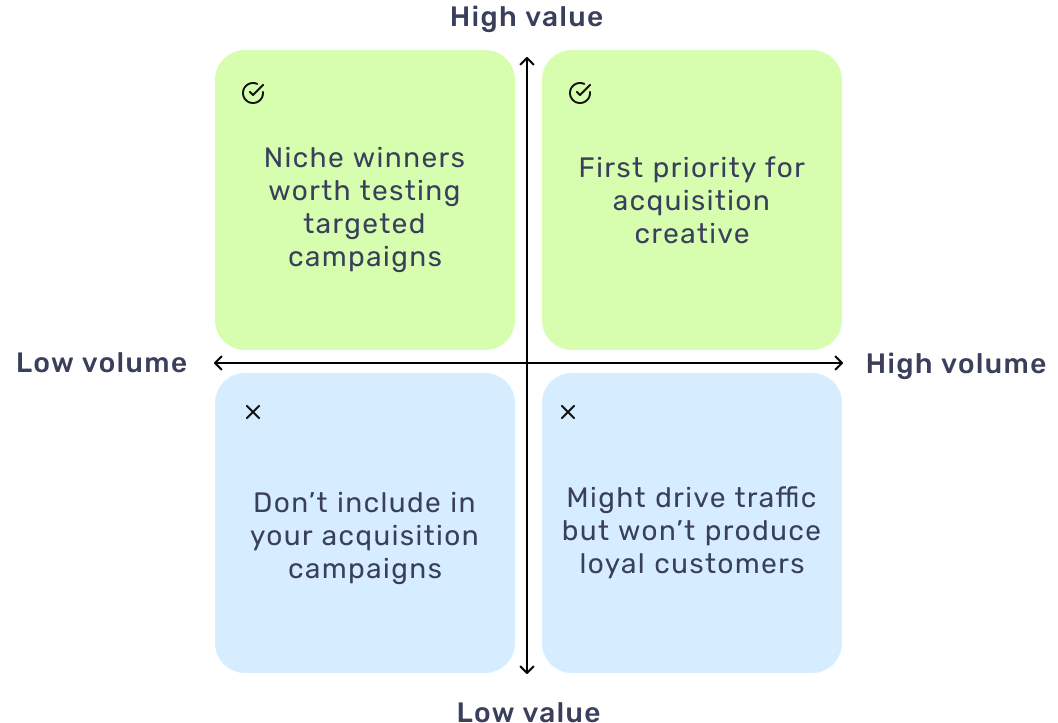
Once you know your hero products, feature them prominently in your paid creative. This single change, swapping a generic brand ad for one that leads with the product most likely to attract a high-value first buyer, can shift your cost-per-acquisition significantly because you're attracting prospects with a higher propensity to convert and stick.
How to take action: Run a first-product analysis on your customer database. For each product category, calculate the number of first-time purchases and the average 12-month value of those customers. Plot these on a simple 2x2 matrix. Feature your top-right quadrant products in acquisition campaigns. Lexer's customer analytics platform makes this analysis accessible to marketing teams without needing SQL or a data analyst.
4. Reduce long-term acquisition costs by converting one-time buyers into repeat customers
Here's a stat that should change how you allocate budget: two-time buyers are roughly nine times more likely to make repeat purchases than one-time buyers. Every customer you successfully move from one purchase to two purchases is a customer you never need to re-acquire.
Most retailers treat acquisition and retention as separate budget lines. But every dollar spent converting an existing one-time buyer into a two-time buyer reduces your future acquisition burden, because that customer is now on a path toward self-sustaining loyalty.
The key is timing. Analyse the gap between first and second purchases for your highest-value customers. You'll often find a sweet spot, say 14 to 30 days, where the conversion rate to second purchase is highest. Target one-time buyers within that window with relevant product recommendations, a modest incentive, or a "complete your look" message that references their first purchase.
This approach works across channels. Trigger an email sequence for opted-in customers. Run paid retargeting for those who haven't opted in. Use SMS if you have consent. The message needs to be timely and relevant to what they just bought.
How to take action: Segment your one-time buyers by days since purchase and first product category. Identify the window where second-purchase conversion is highest. Build an automated flow, email, paid social, or SMS, that targets buyers within that window with product recommendations based on what they purchased. Lexer's customer acquisition platform enables you to automate these lifecycle journeys and sync audiences to your activation channels so the right message reaches the right customer at the right time.
5. Shift acquisition budget from paid media to owned-channel database growth
Paid media is a rental. You pay every time you want to reach someone, and the cost goes up every year. Owned channels, email, SMS, loyalty programs, are assets. Once someone is in your database and opted in, you can reach them repeatedly at near-zero marginal cost.
The smartest retailers are using paid media to build their owned audience, not just drive immediate sales. Run prospecting campaigns specifically designed to capture email addresses and SMS opt-ins rather than immediate conversions. Sweepstakes, giveaways, exclusive product drops, and gated content all work. The key is that the offer is enticing enough to get the sign-up and specific enough to attract quality prospects rather than freebie seekers.
This inverts the typical paid media ROI calculation. Instead of measuring a prospecting campaign solely on immediate ROAS, measure it on cost-per-subscriber acquired and the downstream value of those subscribers over 6 to 12 months. When you can acquire an email subscriber for $2 to $5 through a well-targeted prospecting campaign and then convert them through owned channels at a fraction of the cost of paid acquisition, the overall blended CAC drops dramatically.
Follow up immediately after opt-in. Direct new subscribers to a relevant product page. Trigger a welcome email series that introduces your brand and features your hero products. Send non-winners a consolation discount. These post-signup conversions often pay for the campaign itself, making the database growth effectively free.
How to take action: Allocate 10 to 15% of your acquisition budget to database-building campaigns rather than direct-conversion campaigns. Design a sweepstakes or gated offer featuring your hero products. Capture email, name, gender, and one preference question on the sign-up form. Trigger an automated welcome series immediately after opt-in. Measure success by cost-per-subscriber and 90-day conversion rate. Lexer's survey and form tools let you build branded sign-up experiences that automatically enrich customer profiles in the CDP, so every new subscriber is immediately actionable for audience segmentation and targeting.
Smarter acquisition means higher-value customers at lower cost
Every tactic in this list points to the same principle: use data to be more precise about who you target, more disciplined about who you exclude, and more intentional about converting new buyers into repeat customers. The brands that master this spend less per customer acquired and extract more value from every relationship over time.
Book a demo to see how Lexer's CDP helps retail brands reduce customer acquisition costs through smarter segmentation, audience suppression, and lifecycle automation.