
July 2, 2026
|
5
minute read
Customer retention strategies for retail: a data-driven guide




The most effective retail retention strategies combine three things: segmenting customers by recency, frequency, and spend (RFM), watching for behavioural signals that a customer is drifting before they fully lapse, and using predictive scoring to flag at-risk customers early enough to act. Retailers who run all three off a unified customer profile consistently outperform retailers running ad hoc win-back campaigns after the fact.
Why retention determines retail profitability more than acquisition
Retention determines retail profitability more directly than acquisition because small improvements in retention compound into large improvements in profit. According to Bain & Company, increasing customer retention by as little as 5% can boost profits by as much as 95%, because retained customers spend more per visit, cost nothing to re-acquire, and become cheaper to serve over time.

The mechanics behind that number are visible in repeat purchase data. Smile.io's analysis of over a billion shoppers found that a customer has a 27% chance of returning after a first purchase, but that probability climbs to 49% after a second purchase and 62% after a third. Every purchase a retailer can convert into a second or third order makes every subsequent order more likely. That's why retention strategy should focus disproportionately on the first-to-second purchase window rather than spreading effort evenly across the customer base.

Personalised retention activity adds a separate, compounding layer of value. McKinsey's research found that personalisation most often drives a 10 to 15% revenue lift, with company-specific results ranging from 5 to 25% depending on sector and execution. Retailers running customer segmentation well are the ones capturing the upper end of that range.

Framework one: RFM retention segmentation
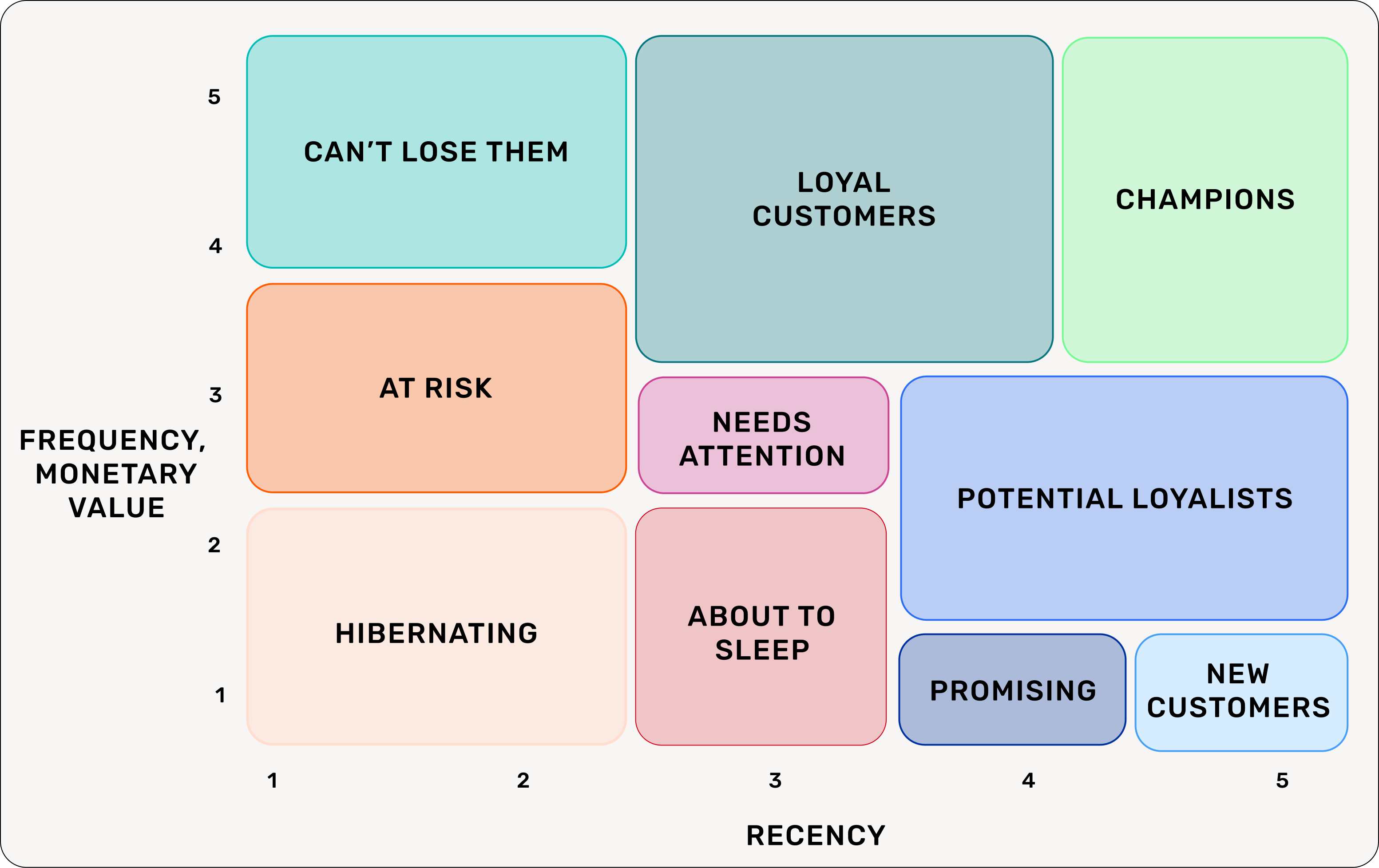
RFM segmentation groups customers by how recently they purchased, how often they buy, and how much they spend, then ranks them so retention effort goes to the customers worth protecting most. A customer who buys frequently and spends well but hasn't purchased in 90 days needs a different response than a customer who has never spent above $40.
In practice, this means building segments such as high-value lapsing (high frequency and spend, recency slipping), reliable mid-value, and one-time low-value, then setting a different retention play for each. High-value lapsing customers warrant a personal, non-discount-led outreach. One-time low-value customers often aren't worth significant retention spend at all; a standard automated flow is enough.
Framework two: behavioural retention signals
Behavioural retention signals are forward-looking indicators, such as declining email engagement, longer gaps between purchases, and narrowing product category exploration, that show a customer is drifting before they fully churn. Recency is consistently the strongest of these signals: a customer who has gone meaningfully beyond their normal purchase cycle has crossed from "on schedule" to "showing early churn risk."
These signals only become useful when they're tracked at the segment level rather than the brand level, because a six-week gap means something different for a beauty replenishment customer than for a furniture buyer. Reading them in aggregate just produces noise; reading them per segment produces an actionable trigger.
Framework three: predictive churn scoring
Predictive churn scoring calculates the probability that each individual customer will lapse, based on their purchase frequency, category behaviour, and engagement pattern, so retention spend goes to the customers who are both at risk and worth protecting. This replaces a blanket approach (discounting the entire database) with targeted intervention on the customers where it actually moves the needle.
High-risk, high-value customers get proactive outreach. Low-risk customers get left alone, protecting margin rather than training the whole database to wait for a discount. Retailers using predictive analytics for retention typically find that targeted churn-risk campaigns outperform broad retention sends on cost per retained customer, simply because the spend is concentrated where it has the best odds of working.
How a CDP operationalises retention
A CDP operationalises retention by closing the loop between segmentation, activation, and measurement, so the same unified customer profile that builds an RFM segment also triggers the campaign and reports on whether it worked. Without that loop, retention work tends to live in three disconnected tools: one for segmentation, one for sending, and a spreadsheet for measuring results weeks later.
That gap is also where most retailers lose the data needed to improve the next campaign. A customer data platform built for retail keeps purchase, engagement, and loyalty data in one place, so a churn-risk score updates the moment new behaviour comes in, the at-risk segment refreshes automatically, and the campaign result feeds straight back into the model.
What this looks like in practice
CALECIM® used Lexer's unified customer data to find its most engaged customer segment and build targeted, behaviour-triggered communication sequences, achieving a 31% increase in repeat sales. The result came from acting on a segment that already existed in the data, not from a new acquisition channel.

Sur La Table used a similar approach to convert first-time buyers into repeat customers, building a four-point framework (data and insight, measurement, automation, and a connected single customer view) to identify which products and timing windows actually drove a second purchase.

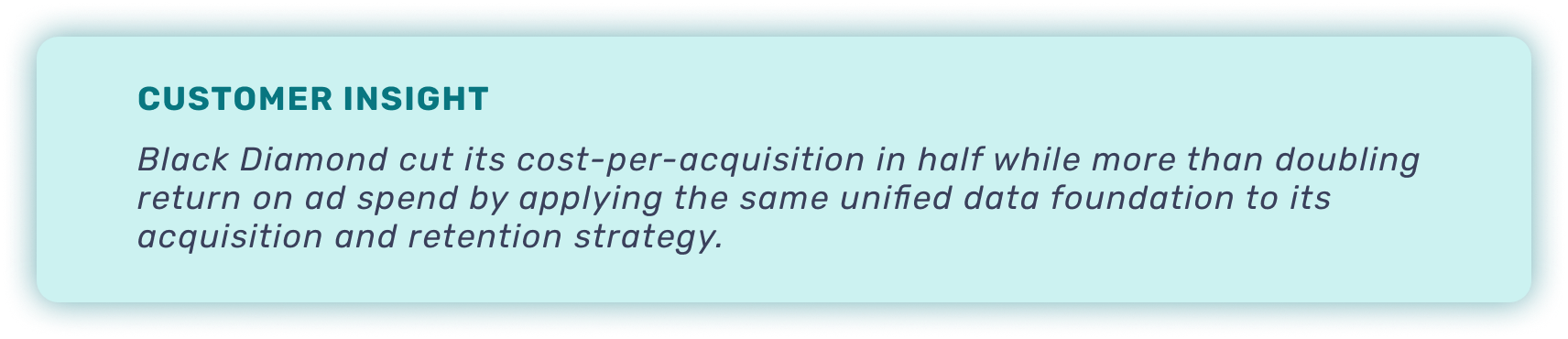
Black Diamond applied the same unified-data foundation to its acquisition and retention strategy and cut its cost-per-acquisition in half while more than doubling return on ad spend within its first 100 days, evidence that retention and acquisition improve together once the underlying customer data is unified.
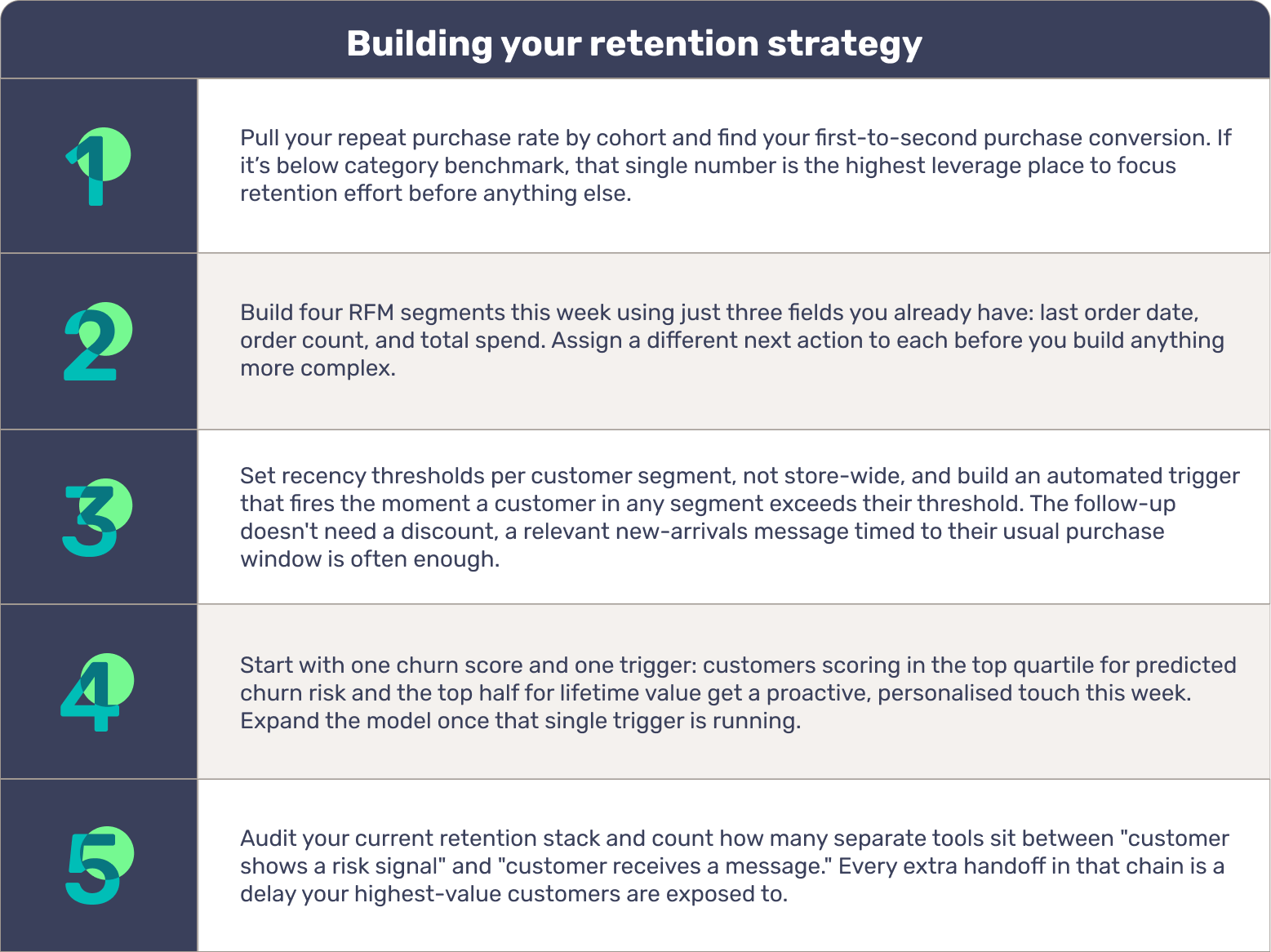
Building your own retention strategy
The bottom line
Retention strategy in retail works when it's built on three layers: knowing which customers matter most (RFM), watching for the signals that they're drifting (behavioural data), and acting on risk before it becomes churn (predictive scoring). Each layer depends on the same thing underneath it, a unified, continuously updated view of every customer.
Book a demo to see how Lexer helps retail brands turn customer data into retention that compounds.
FAQs
What are the most effective customer retention strategies in retail?
The most effective retail retention strategies combine RFM segmentation to prioritise which customers matter most, behavioural signals to catch early drift before a customer fully lapses, and predictive churn scoring to target intervention where it has the highest return. Retailers running all three off a unified customer profile consistently outperform those running reactive, one-off win-back campaigns.
How do I use behavioural data to improve customer retention?
Use behavioural data by tracking signals such as declining email engagement, lengthening gaps between purchases, and narrowing category exploration, then setting segment-level thresholds that trigger an automated, personalised response. Behavioural data works best when read per customer segment rather than brand-wide, since a normal purchase gap varies significantly by category.
How does a CDP improve customer retention?
A CDP improves customer retention by unifying purchase, engagement, and loyalty data into one profile per customer, so churn-risk scores and segments update continuously and retention campaigns trigger automatically rather than manually. This closes the loop between knowing a customer is at risk and actually reaching them in time to intervene.