
June 29, 2026
|
6
minute read
How AI is transforming retail personalisation, and what your customer data strategy needs to keep up




AI in retail is no longer a future capability. It is being applied to personalisation right now, and the brands getting ahead are the ones whose customer data is already unified and ready for it. Here is what AI is actually doing in retail marketing today, and what your strategy needs to keep up.
The short answer
AI improves retail personalisation by scoring every customer on predicted behaviour (likely next purchase, churn risk, lifetime value), generating tailored messages at scale, and building lookalike acquisition audiences from your highest-value customers. The output is only as good as the data going in. Retailers with fragmented, siloed customer data get generic AI outputs. Retailers with a unified customer profile get genuinely personalised experiences across every channel.
According to McKinsey's Next in Personalization 2021 report, personalisation drives 10 to 15 percent revenue lift on average, with company-specific results ranging from 5 to 25 percent. The same research found that 71 percent of consumers expect personalised interactions from brands, and 76 percent get frustrated when it does not happen.
The gap between what customers expect and what most retailers can deliver has never been wider. AI closes that gap, but only for brands whose data infrastructure is ready for it.

1. AI-powered predictive scoring for retail personalisation
AI-powered predictive scoring assigns every customer a set of forward-looking scores, including predicted lifetime value, churn probability, and likelihood to purchase a specific category, so marketers can prioritise outreach by commercial impact rather than recency alone.
Traditional RFM segmentation groups customers by what they have already done. Predictive scoring tells you what they are likely to do next. A customer who bought once six months ago might have a low RFM score but a high predicted lifetime value score if their purchase pattern matches your best customers at the same stage of their lifecycle. Acting on RFM alone means that customer gets treated the same as a genuinely lapsed buyer.
Churn propensity models score customers weekly. A customer with a rapidly declining engagement score gets flagged before they stop buying, giving your team a window to intervene with a relevant offer before win-back campaigns become necessary and expensive.
To apply predictive scoring to your customers, identify your top 20 percent by predicted lifetime value. That segment should receive different messaging, different offers, and a higher service threshold than your mid-value segments. Predictive scoring makes that distinction possible without manual analysis.
2. AI-generated 1:1 personalised retail messaging at scale
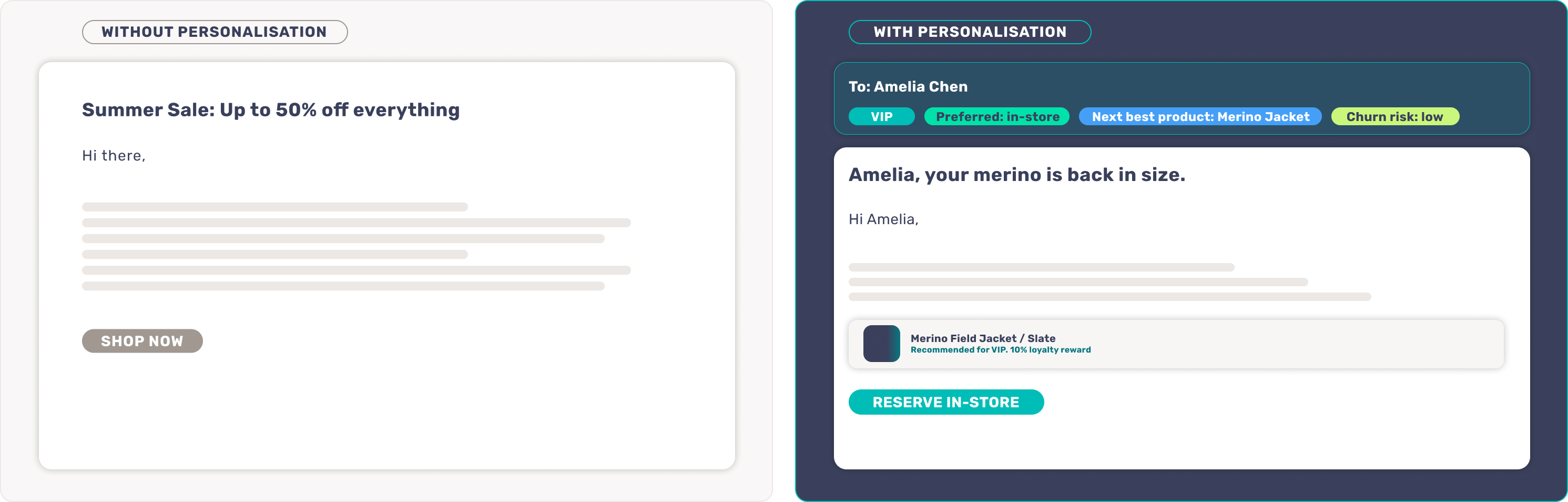
AI generates personalised messages for individual customers at scale, drawing on unified customer data including purchase history, loyalty status, product preferences, and browsing behaviour, so every message is relevant to that specific person rather than their segment.
This is the most visible application of AI in retail marketing right now. The challenge with 1:1 personalisation has always been scale: writing a genuinely tailored message for every customer individually is not feasible, and batch-and-blast campaigns perform poorly because customers can tell the difference. AI solves the scale problem while maintaining the relevance.
Lexer's own analysis of 30,000 personalised messages from leading retail brands found that personalised lifecycle messages convert up to 4x better than generic win-back campaigns. The difference is specificity: a message that references a customer's recent purchase, celebrates a loyalty milestone, or recommends a product that complements what they already own performs dramatically better than a discount code sent to the whole list.

If you aren’t already using personalised messaging, you are falling behind your competitors. Start with your highest-value lapsing customers rather than your full database. A set of 500 to 1,000 carefully selected customers contacted with genuinely relevant AI-generated messages will produce better commercial outcomes than a list of 50,000 contacted with generic campaigns.
3. AI-powered retail audience segmentation for acquisition
AI-powered audience segmentation for retail acquisition uses your existing best customers as the seed for lookalike modelling, identifying the attributes that define high-value buyers and finding new prospects who share those characteristics across paid channels.
First-party data is now the primary lever for acquisition. Third-party cookie deprecation and platform signal loss have eroded the effectiveness of broad demographic targeting. The brands getting the most out of paid media are the ones pushing their cleanest, most specific first-party segments into Meta, Google, and programmatic platforms as the basis for lookalike modelling.
A lookalike audience built from your top 500 customers by lifetime value will outperform a lookalike built from your entire customer list, because the signal is cleaner. AI identifies which behavioural and demographic attributes those 500 customers share and finds new prospects who match.
How to apply this: Build your seed audiences from the top 10 to 15 percent of customers by predicted lifetime value, not by total spend. A customer who bought three times in the past six months is a better seed than one who spent more in a single transaction. The customer acquisition platform should connect directly to your ad platforms so audiences refresh automatically as customer data updates.
4. What your retail tech stack needs for AI personalisation to work
AI retail personalisation produces better results when every customer touchpoint feeds into a single, continuously updated customer profile, because fragmented data produces fragmented outputs.
This is where most mid-market retailers hit the wall. The AI tools exist. The willingness to invest is there. But the data going into those tools is still siloed: ecommerce data in one system, POS data in another, loyalty data in a third, email engagement in a fourth. An AI model trained on incomplete data produces incomplete outputs. You cannot generate a meaningful churn propensity score from ecommerce data alone if 40 percent of your customers primarily buy in-store.
The data layer AI needs is a single customer view platform that resolves identities across channels and keeps customer profiles updated continuously. Without it, AI personalisation initiatives produce results that look impressive in a vendor demo and disappoint in practice.
Before evaluating AI personalisation tools, audit your data completeness. What percentage of your customers have both an online and in-store purchase history linked to a single profile? What percentage have an email address matched to a transactional record? If those numbers are low, the first investment is in identity resolution and data unification, and AI tools come second.
FAQs
How is AI being used in retail today?
AI is being applied to retail across predictive customer scoring, personalised message generation, inventory forecasting, and acquisition audience building. In marketing specifically, AI scores customers on predicted lifetime value and churn risk, generates tailored messages at scale, and builds lookalike audiences from first-party data. The most commercially impactful applications are the ones closest to the customer relationship: segmentation, messaging, and retention.
What is the role of AI in retail personalisation?
AI makes personalisation scalable. Retailers have always known that relevant, tailored communication outperforms generic campaigns. AI removes the manual effort that previously made personalisation at scale impossible. It scores customers individually, generates messages tailored to each person's purchase history and preferences, and identifies which customers are most likely to respond, lapse, or convert, so marketing effort concentrates where it has the highest commercial impact.
Does AI personalisation in retail actually improve revenue?
According to McKinsey's Next in Personalization 2021 research, personalisation drives an average of 10 to 15 percent revenue lift, with company-specific results ranging from 5 to 25 percent depending on sector and execution maturity. Faster-growing companies derive 40 percent more of their revenue from personalisation than slower-growing counterparts. The revenue impact is real, but it scales with data quality. Brands with unified customer profiles see materially better results than those working with fragmented data.