April 17, 2026
|
5
minute read
How to build a single customer view for your retail brand




Retail brands typically collect enough customer data to run effective, personalised marketing. However, this data lives in four or five different systems, none of which talk to each other. A customer who buys in-store, browses online, and redeems loyalty points incorrectly appears as three separate records. A single customer view refers to the unification of these records.
The short answer: what is a single customer view and how do retailers build one?
A single customer view (SCV) is a unified profile that consolidates every data point about a customer, from every channel and system, into one record. For a retail brand, this means purchase history from ecommerce and POS, email engagement data, loyalty programme activity, browsing behaviour, and any service interactions, all merged under a single customer identity. Retailers build an SCV by connecting their data sources to a Customer Data Platform (CDP), which handles identity resolution and deduplication to produce a persistent, accurate customer profile.
Why a single customer view matters for retail customer data strategy
Retailers with fragmented customer data cannot personalise at scale, and they cannot retain customers they cannot accurately identify.
The practical consequences are significant. According to McKinsey, personalisation can lift revenues by 5 to 15% and reduce marketing costs by 10 to 30%. But personalisation is only possible when you have a complete picture of the customer. If your email platform shows a customer as lapsed because they haven't purchased online in 90 days, but they've bought in-store twice in that period, you will send a win-back campaign to an active customer. That's not just a wasted send; it signals to the customer that you don't know who they are.
The same fragmentation problem shows up in acquisition. Retailers spending on paid social lookalike audiences need a clean, complete seed audience to generate meaningful matches. A seed list built from one channel's purchase data, rather than a unified customer record, produces weaker lookalikes and higher acquisition costs.
Tip: Before evaluating any technology, map your current data sources. List every system that holds customer data (ecommerce platform, POS system, loyalty platform, email marketing tool, customer service software) and identify what customer identifier each system uses. This mapping exercise reveals where identity gaps exist and what data you are currently unable to connect.
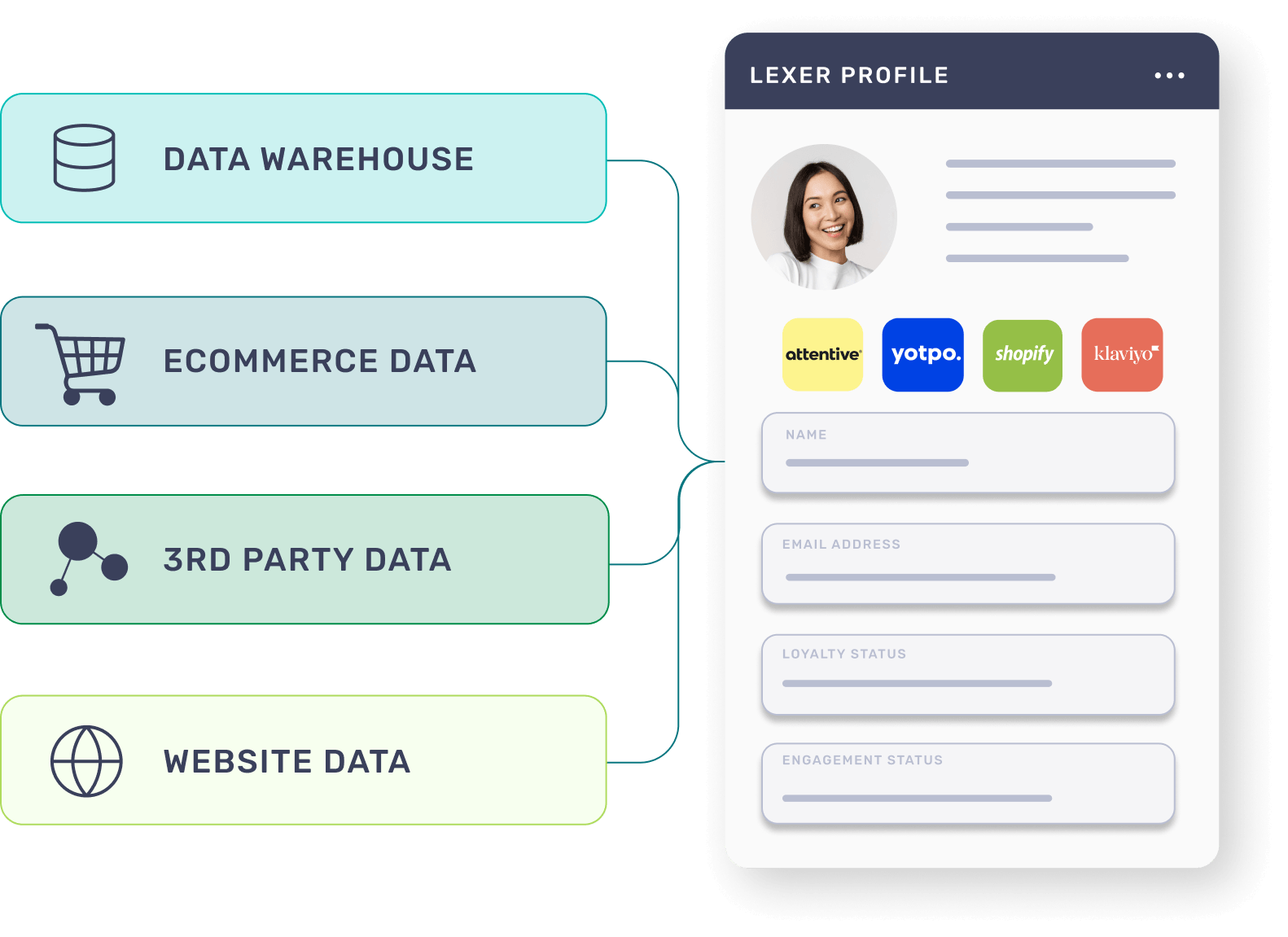
Step 1: Connect your data sources to a single platform for a unified customer profile
A single customer view requires that all your customer data flows into one place. In practice, this means connecting each of your data sources, whether through native integrations, APIs, or data feeds, to a central platform that can ingest and store the data in a structured way.
For most mid-market retailers, the relevant data sources are: an ecommerce platform (Shopify, Magento, or similar), a POS system (Square, Lightspeed, or similar), a loyalty or rewards platform, an email and SMS marketing tool, and potentially a customer service platform.
A Customer Data Platform is designed specifically to receive data from all of these sources without requiring heavy engineering work. Lexer, for example, integrates directly with Shopify, common POS systems, and major marketing platforms, pulling customer data into a centralised profile that updates in near real time.
Follow this link to review Lexer’s integrations catalog: integrations library.
Tip: Prioritise connecting the data sources that hold transactional history first. Purchase data is the most valuable input for building customer profiles because it drives your highest-signal segments (by recency, frequency, and value). Email engagement and loyalty data add depth once the purchase foundation is in place.
Step 2: Resolve customer identities across channels using a retail CDP
Collecting data from multiple sources is only the first step. The harder problem is determining which records across different systems belong to the same customer. This is called identity resolution, and it is where most manual approaches to building a single customer view break down.
A customer might use their email address at the ecommerce checkout, a phone number at the POS, and a loyalty card number that links to a third identifier. Without identity resolution, these appear as three separate customers whereas with it, they are collapsed into one unified profile.
Identity resolution works by matching customer records across common identifiers (email address, phone number, loyalty ID, device ID) and applying probabilistic matching where exact identifiers are absent. The result is a deduplicated customer record that accurately represents one real person across all their interactions.
According to Salesforce, the average enterprise uses over 900 applications, and data and analytics leaders estimate that 19% of company data remains siloed or inaccessible. Identity resolution directly addresses this problem by connecting siloed records into a coherent whole.
Lexer's unification and identity resolution capability handles this automatically, matching records across sources and maintaining a persistent customer profile that updates as new data arrives.
.png)
Step 3: Enrich your single customer view with behavioural and predictive data
A basic single customer view consolidates historical transaction and engagement data. A more powerful SCV also includes derived data, such as customer segments, predicted lifetime value, churn risk scores, and category affinity signals.
These enriched attributes make the SCV actionable for marketing. Instead of simply knowing that a customer has purchased three times, you know that they have a high predicted lifetime value, a low churn risk, a strong affinity for a particular product category, and are likely to respond to email over SMS.
Segmentation is the bridge between the raw SCV and marketing activation. Once customers are profiled in a unified way, you can build segments based on any combination of attributes, including purchase behaviour, engagement history, predictive scores, and demographic data. These segments update automatically as customer behaviour changes.
Lexer's customer segmentation platform lets retail marketers build and update segments directly from the unified customer profile, without needing to request data exports from a technical team.
Step 4: Activate your single customer view across marketing channels
A single customer view creates value when it informs action. The unified profile should feed every customer-facing channel: email, SMS, paid social, in-store service, and any other touchpoint where knowing the full customer history improves the interaction.
In practice, this means connecting your SCV platform to your marketing execution tools so that segments flow through automatically and audience lists stay current without manual exports. A customer who moves from "at risk" to "lapsed" should exit the re-engagement flow and enter the win-back sequence without anyone having to manually update a list.
For paid social, activating your SCV means pushing high-value customer segments to Meta and Google as custom audiences for suppression (so you're not acquiring customers you already have) and as seed audiences for lookalike modelling. According to research on lookalike audience performance, using enriched first-party data as a seed audience reduces cost per acquisition by 20 to 35% compared to platform-only modelling.
For in-store teams, access to the SCV through a clienteling tool means that a store associate can see a customer's full purchase history, their preferred categories, and their loyalty status before making a service or product recommendation.

What customer data infrastructure do you need to build a single customer view?
Building a single customer view requires three infrastructure components: a data ingestion layer (to bring data in from all sources), an identity resolution layer (to match and deduplicate records), and an activation layer (to push segments and audiences to marketing tools).
A Customer Data Platform provides all three. Most mid-market retailers choose a CDP because the alternative, building these capabilities in-house using a data warehouse and custom engineering, requires significant technical resources and ongoing maintenance. A CDP is designed to be operated by marketing teams rather than data engineering teams, which means shorter time to value and lower ongoing cost of ownership.
For retailers evaluating which CDP to choose, the questions that matter most are:
- Does it integrate natively with our existing stack?
- What is the match rate it achieves on identity resolution?
- Can our marketing team build and update segments without a data team?
- How does it handle in-store (POS) data alongside ecommerce data?
For a practical framework for evaluating CDP options, Lexer's retail solutions page outlines how the platform is built specifically for the mid-market retail use case.
FAQs
What is a single customer view and why do retailers need it?
A single customer view is a unified customer record that consolidates data from every channel and system into one profile per customer. Retailers need it because customer data typically lives in separate platforms, ecommerce, POS, loyalty, email, that cannot identify the same customer across sources.
How do retailers build a single customer view?
Retailers build a single customer view by connecting all customer data sources to a Customer Data Platform, which ingests the data and applies identity resolution to merge records that belong to the same customer. The process involves mapping your data sources, establishing integration connections, running identity resolution to deduplicate records, and then enriching the unified profile with segments and predictive attributes before activating it across marketing channels.
What is identity resolution in retail customer data?
Identity resolution is the process of matching customer records from different systems that belong to the same person. A customer might use an email address at the ecommerce checkout, a phone number at the POS, and a loyalty card number in-store. Identity resolution matches these records using shared identifiers and probabilistic matching, producing a single deduplicated customer profile.
Keep reading
Related resources
More from the Lexer library on the same topics.

%20(1).png)