
April 2, 2026
|
5
minute read
4 ways to improve your retail customer journey using data




Most retail brands know their customer journey could be better. The harder question is where to start, and what data will actually make a difference. This post breaks down four practical ways to use customer data to improve your retail customer journey, from the first touchpoint through to post-purchase retention.
Why improving your retail customer journey matters right now
Shoppers have more options than ever, and their expectations have shifted accordingly. According to McKinsey's Next in Personalisation report, 71% of consumers now expect personalised interactions from the brands they shop with, and 76% report frustration when those expectations go unmet.
The gap between expectation and execution is wide. A 2024 Forbes survey found that 81% of customers prefer companies that offer personalised experiences, yet research consistently shows that most brands are still working from fragmented data, disconnected systems, and siloed teams.
The result is a customer journey that feels disjointed: a customer browses in-store, receives an email that ignores their visit entirely, then gets retargeted on social for a product they already bought.
The good news is that getting the basics right simply requires better use of data you most likely already have.
1. Unify your customer data into a single customer view
The single most common barrier to improving the retail customer journey is data that exists in too many places, in too many formats, with no way to connect it into a coherent picture of the individual customer.
When purchase history lives in your POS, loyalty data in a separate CRM, email engagement in an ESP, and web behaviour in an analytics tool, your teams cannot make good decisions about any individual customer. You end up with averages and guesses rather than genuine insight.
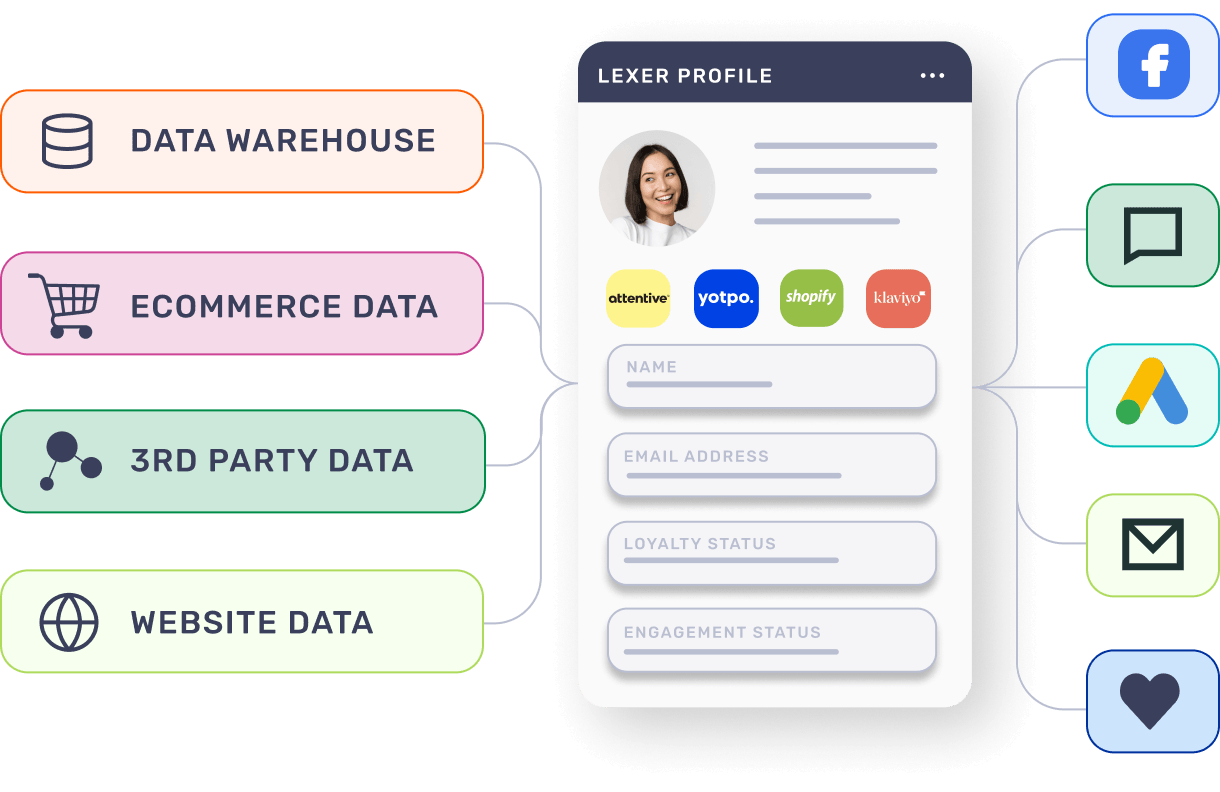
A single customer view consolidates every interaction, across every channel and touchpoint, into one enriched, deduplicated customer profile. That profile becomes the foundation for everything else: segmentation, personalisation, attribution, and activation. Without it, the four steps that follow are significantly harder to execute.
Quick actions:
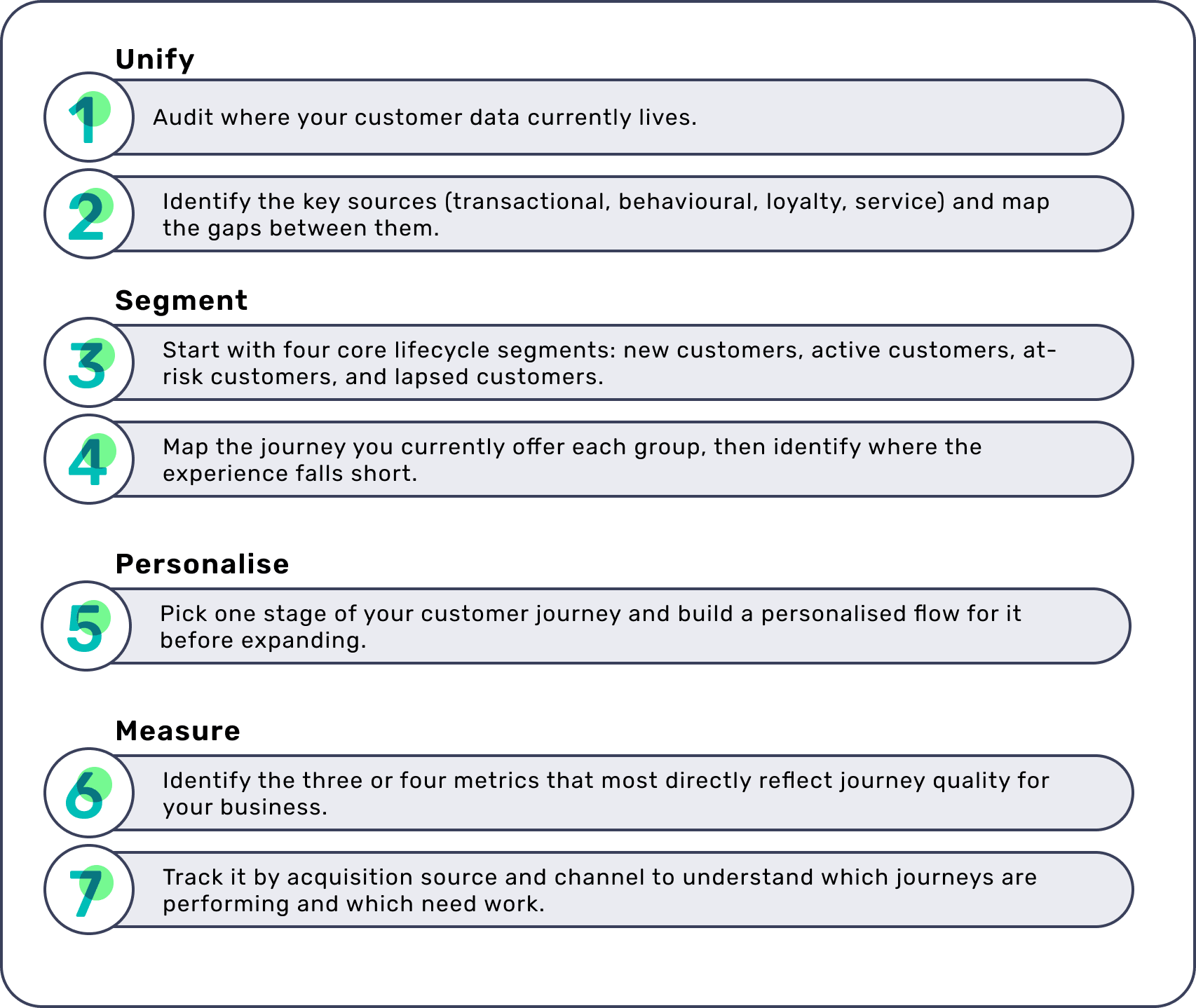
- Audit where your customer data currently lives.
- Identify the key sources (transactional, behavioural, loyalty, service) and map the gaps between them.
The goal is to build a unified profile that your team can act on. Customer identity resolution is the technical foundation for this: matching records across sources so that the same person shopping online and in-store is recognised as one customer, not two.
Lexer's Customer Data Platform (CDP) builds this single view automatically, pulling in data from your existing sources and resolving customer identities across channels so your team always works from a complete, up-to-date profile.
2. Segment your customers by lifecycle stage and value
Everyone knows that different customers need different experiences. If you’re not personalising customer experience you’re falling behind.
However, meaningful customer segmentation goes beyond basic demographics. The most useful segments for journey improvement are built around behaviour and value: customers who have purchased once and not returned, lapsed loyalists who used to buy frequently, high-CLV customers at risk of churn, and first-time buyers with strong potential for second purchase.
Each of these groups needs a different experience. A first-time buyer needs onboarding and reassurance. A high-CLV customer at risk of lapsing needs proactive, personal outreach. A customer who has bought twice and not returned in 90 days needs a reason to come back that connects to what they bought, not a generic campaign.
Research from McKinsey shows that fast-growing companies drive 40% more of their revenue from personalisation than slower-growing counterparts. The companies executing at that level are not doing anything fundamentally different, but rather applying data to serve the right experience to the right customer at the right moment.
Quick actions:
- Start with four core lifecycle segments: new customers (purchased once, within 90 days), active customers (repeat purchasers), at-risk customers (historically active, no purchase in 90–180 days), and lapsed customers (no purchase in 180+ days).
- Map the journey you currently offer each group, then identify where the experience falls short.
Predictive CLV and churn risk scores make this segmentation far more precise. Lexer's customer segmentation platform surfaces these segments automatically, updated in real time as customer behaviour changes.
%20(1).png)
3. Personalise each stage of the retail customer journey with behaviour data
Segmenting your customers by lifecycle stage gives you the foundation. What you do with those segments is where the retail customer journey either improves or stays broken.
Personalisation at the journey level means connecting what you know about a customer's history, preferences, and current behaviour to every touchpoint they encounter. That includes the products recommended on your website, the subject line they see in an email, the offer triggered by a store visit, and the message sent after a high-value purchase.
The challenge most retail marketers face is that only 35% of companies currently offer omnichannel personalised experiences, despite 73% of consumers using multiple channels during their shopping journey. That gap is a direct consequence of disconnected data. When your online and offline data cannot talk to each other, the customer journey will always feel fragmented to the person living it.
Behaviour data is the key input here. What has the customer browsed but not bought? What categories do they return to consistently? When do they typically purchase? Are they a seasonal buyer or regular repurchaser? What channels drive their conversions? These signals, combined with historical transaction data, allow you to build experiences that feel relevant rather than generic.
Quick action list:
- Pick one stage of your customer journey and build a personalised flow for it before expanding.
Post-purchase is often the highest-impact starting point: most brands under-invest here, yet it is the moment when customer attention is highest and the opportunity to drive a second purchase is strongest. A post-purchase sequence triggered by product category, including relevant cross-sell recommendations and a timed check-in, is a practical first step. Lexer's audience activation capabilities allow you to build these flows using real-time customer data and push them to your existing channels without duplicating effort across tools.
%20(1).png)
4. Measure your retail customer journey with data that connects to outcomes
Most retail teams measure journey performance in channel silos: email open rates, ad click-through rates, website conversion rates. These metrics tell you how individual channels are performing in isolation.
To genuinely improve the retail customer journey, you need measurement that connects behaviour across channels to outcomes: repeat purchase rate, average order value growth, CLV trajectory, and churn. Without this, it is impossible to know whether the journey changes you are making are working.
This is the shift from channel attribution to customer lifecycle attribution. Rather than asking "which ad drove this conversion?", you ask: "Which combination of touchpoints produce the highest-value customers?”, and “what does the journey look like for customers who go on to become loyal?" Those are fundamentally different questions, and they require a fundamentally different data model.
The Lexer analytics platform gives you this view by connecting individual customer behaviour across channels to actual business outcomes so you can identify which journey improvements are driving revenue. For a deeper look at how this works in practice, the customer lifecycle attribution guide walks through how to measure the full journey rather than individual channel events.
Quick action list:
- Identify the three or four metrics that most directly reflect journey quality for your business. Repeat purchase rate within 90 days of first purchase is a strong leading indicator of customer journey health as it tells you whether the post-acquisition experience is strong enough to convert a browser into a buyer into a returning customer.
- Track it by acquisition source and channel to understand which journeys are performing and which need work. For retail teams running reporting across siloed tools, this often requires consolidating data into a single analytics environment before the patterns become visible.
Pulling it together
Improving your retail customer journey requires a set of compounding improvements built on better data. Each step described above makes the next one more effective. A unified customer profile enables better segmentation. Better segmentation enables more relevant personalisation. Better personalisation produces better measurement outcomes. And better measurement tells you where to focus next.
The brands that get this right do not have fundamentally different ambitions from the ones that struggle. They have better foundations: cleaner data, clearer segments, and the tooling to act on insights across the full journey rather than one channel at a time.
If you are working to improve your retail customer journey and want to understand how a CDP can accelerate each of these steps, book a demo to see how Lexer's retail analytics and activation capabilities work in practice.