
May 26, 2026
|
10
minute read
How Cafe du Cycliste grew repeat revenue by knowing exactly who to target
.png)



This case study shows how RFM transforms a list of customers into a clear action plan and what happens when you act on it in real time. We break down why the framework has stood the test of time, how Lexer's enhanced model goes further with an Engagement dimension, and what it looks like in practice through Cafe du Cycliste: a premium cycling apparel brand that used Lexer to turn customer insight into segment-led campaigns that drove measurable retention and revenue impact.
Every brand has a mix of customers at different stages of engagement, value, and intent. Some are highly loyal and drive a disproportionate share of revenue. Others are new, disengaging, or at risk of churning. The challenge is how to use your customer data to focus on those who matter most.
This is where RFM becomes essential. RFM stands for Recency, Frequency, and Monetary Value, a proven framework used to understand and segment customers based on their purchasing behaviour. When combined, these three dimensions provide a clear picture of customer value and engagement. More importantly, they help answer one of the most critical questions for any brand: which customers are most valuable, and which ones are at risk of being lost?
.png)
The origin of RFM
Before dashboards and email marketing, businesses had the same problem they have today. They had a list of customers and needed to decide who to spend money on.
Catalog retailers and direct mail marketers of the 1960s to 1980s relied on physical mail to drive sales. Every letter and promotion had a real cost, which limited who they could send to.
Over time, these marketers noticed consistent patterns. Customers who bought more recently were more likely to buy again. Those who bought more frequently were more loyal. Those who spent more were more valuable. So instead of guessing, they built a ranking system based on three variables: how recently someone purchased, how often they purchased, and how much they spent.
The result? Higher response rates, more revenue, and less wasted spend. That simple, powerful framework became RFM.
Today, the core principle hasn't changed. We still need to answer who our best customers are, who is about to churn, and where to invest. The difference is that we no longer just analyse this. With tools like Lexer, we can act on it in real time.
Why RFM works
Even with all the data available today, brands still struggle with who to focus on. RFM cuts through that noise by:
- Focusing on behaviour that drives revenue, not vanity metrics.
- Identifying who to prioritise, so you stop guessing and start acting with confidence.
- Powering personalisation at scale. The right message to the right customer.
- Improving retention and lifetime value (LTV) by growing value from customers you already have.
Consider two customers, Sarah and Mike.

Without RFM, Sarah and Mike are both just customers. With RFM, Sarah scores 5/5 across Recency, Frequency, and Monetary Value. She sits in the Champions segment. The strategy? Reward her, upsell her, give her VIP treatment. Mike scores 1/5 for Recency, 2/5 for Frequency, and 2/5 for Monetary Value. He's At Risk. The strategy? A win-back sequence with a compelling offer before he fully churns.
Same data. Completely different strategies. That is the power of RFM.
New RFM attributes in Lexer
Lexer has built a scoring-based RFM Enhanced model directly into the platform. Each customer receives individual scores for Recency, Frequency, Monetary Value, and a fourth dimension unique to Lexer: an Engagement (E) score based on activity across email and SMS channels.
Research consistently shows that customers who are actively connecting with your brand through email and SMS have a higher lifetime value. The Engagement score reflects this reality, giving weight to customers who may not have purchased recently but are still actively interested.
The full segment framework
Every customer profile is scored and placed into one of the following segments:

Flexibility by design
The framework includes sensible defaults, but can be adapted to reflect the unique shape of your customer base. For instance, a brand where the majority of customers are one-time buyers can adjust the Frequency scoring logic to look at total item count rather than total orders. What matters is that the model reflects your business reality, not a generic template.
Current and prior RFM: Watching movement over time
One of the most significant advances in Lexer's new RFM Attributes is the addition of a Prior RFM Segment attribute alongside the current one. This pairing allows teams to see exactly where a customer came from and where they sit today.
This unlocks a critical strategic capability: tracking segment movement over time. Rather than seeing a static snapshot of your base, you can monitor how effectively your campaigns are moving customers up through the lifecycle, or where high-value customers are beginning to slip.
From framework to execution: Cafe du Cycliste
Cafe du Cycliste is a premium cycling apparel brand with a global presence and a highly engaged customer base. As the brand expanded across regions and currencies, the team prioritised delivering a more personalised and consistent customer experience. But their existing data infrastructure made this increasingly difficult.
The challenge
As Cafe du Cycliste scaled, their customer data became more complex and fragmented. Multiple markets, currencies, and touchpoints made it difficult to unify customer behaviour into a single, actionable view.
The team had a strong desire to better understand their customers and deliver more personalised experiences across channels. But they couldn't translate that data into real-time action. This created several practical challenges:
- Difficulty prioritising high-value customers from those at risk of churning.
- Campaigns that were broad and product-led rather than tailored to lifecycle stage.
- Misalignment between CRM and paid media strategies.
- Limited visibility into how customer value changed over time.
The solution
To address this, Cafe du Cycliste implemented Lexer as a central platform for unifying customer data and operationalising RFM segmentation.
Rather than treating RFM as a reporting tool, the team used it as a core framework for customer strategy. Every decision about who to contact, how to contact them, and what to offer them was grounded in where that customer sat in the RFM model.
Building actionable customer segments
Using Lexer's RFM Attributes, Cafe du Cycliste segmented their entire customer base based on real purchasing behaviour. The team could clearly see:
- Their most valuable customers (Champions and Prime Potential)
- High-growth customers building momentum (Fresh Comers and Steady Spenders)
- Customers beginning to disengage (Fading Stars and Needs Attention)
- Customers at risk of churning who required immediate intervention (At Risk)
With this structure in place, the business could prioritise where to invest, where to nurture, and where to intervene.
Activating segments in real time
This is where the strategy came to life. With Lexer, RFM segments are not static. They become fully operational across the marketing ecosystem.
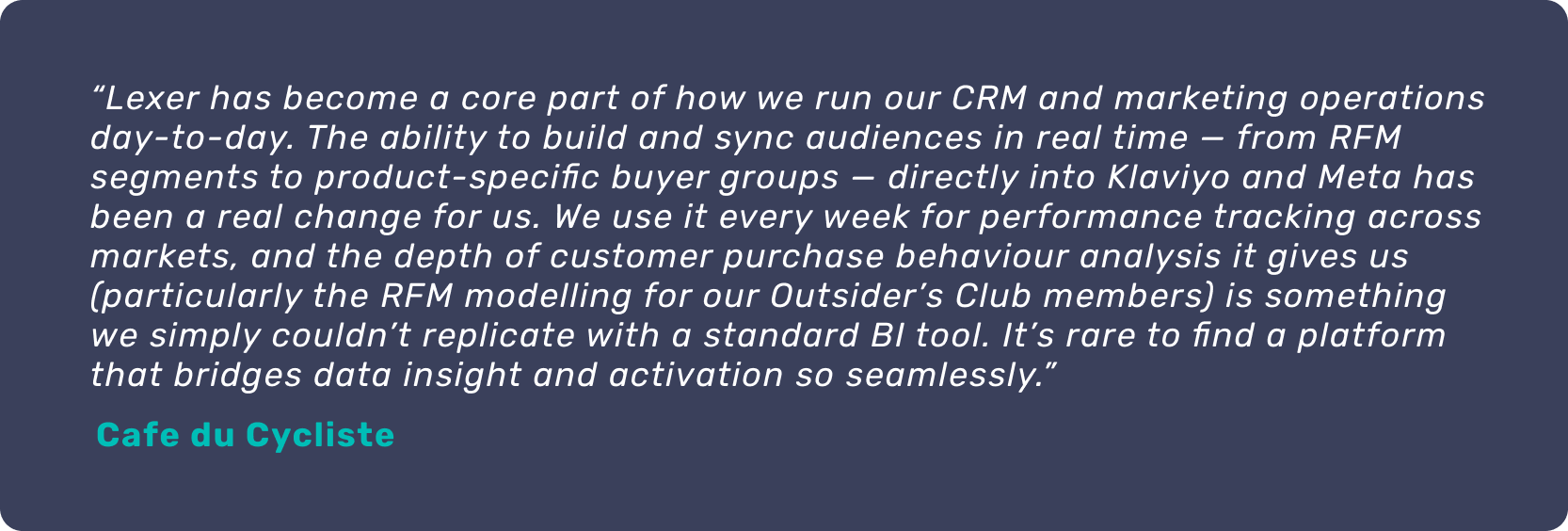
The team built dynamic audiences and synced them directly into Klaviyo for lifecycle marketing and Meta for paid media activation. Customers received consistent, relevant messaging across channels based on their behaviour as it evolved. This removed the traditional gap between insight and execution.
Transforming campaign strategy
With RFM embedded into their workflow, campaigns shifted from product-led to customer-led. Instead of one message to all customers, each campaign was tailored by segment:
- High-value customers received early access and premium messaging, protecting margin.
- Promising customers were guided toward repeat purchases through personalised recommendations.
- At-risk customers were targeted with re-engagement campaigns designed to win them back before they fully churned.
The insight that shaped this approach: recognition and exclusivity carry more weight than discounts for high-value customers. Telling a champion customer their status with the brand connects them more deeply than a 20% off code, and it protects margin at the same time.

Measuring segment movement
A key differentiator in Cafe du Cycliste's approach was tracking how customers moved between segments over time. Rather than focusing only on static segment sizes, the team monitored:
- Movement into higher-value segments (growth signal)
- Decline toward churn (action needed signal)
- The revenue impact of these shifts
The table below illustrates the type of segment movement analysis the team ran to measure the impact of their campaigns:
.png)
This gave the business a clear, actionable view of growth. Were customers becoming more valuable, or slipping away? The revenue impact figures translated marketing activity directly into business outcomes.
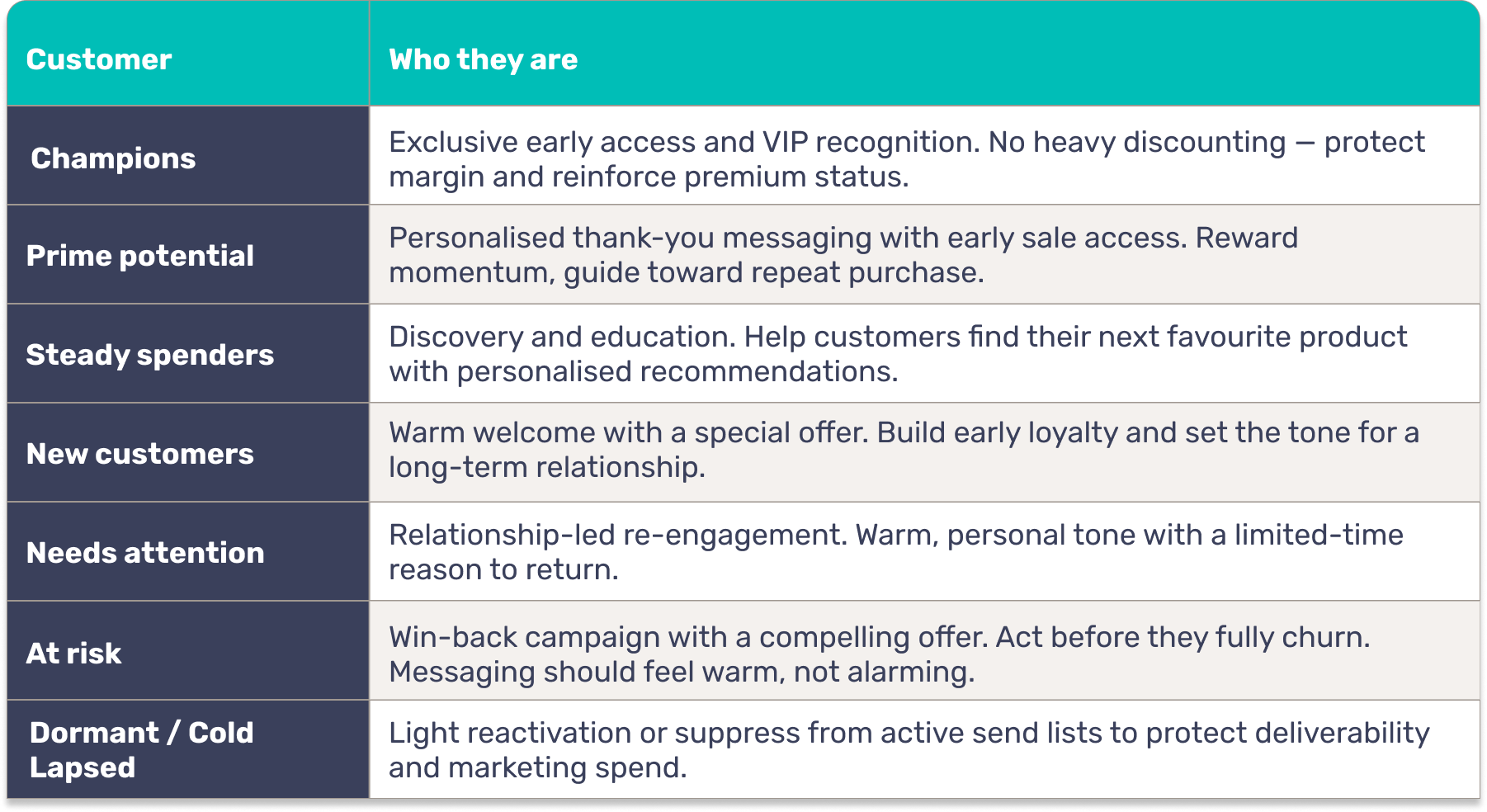
Messaging strategy by segment
With real-time segments in place, Cafe du Cycliste built distinct messaging strategies for each group. The guiding principle: the message doesn't change because of the campaign. The message changes because of the customer.
How to read and use your RFM data
Once RFM segments are live, the data tells a clear story. Here are three questions every marketing leader should be asking regularly:




The results
By operationalising RFM through Lexer, Cafe du Cycliste built a system to actively grow customer value over time. The outcomes included:
- More relevant and personalised messaging across email, SMS, and paid media channels.
- Improved customer retention and repeat purchase behaviour, with clear visibility into the drivers.
- More efficient marketing investment, focused on high-value segments rather than broad acquisition.
- Faster campaign execution through real-time audience syncing into Klaviyo and Meta.
- A measurable framework for tracking customer lifecycle movement and its revenue impact.
Final takeaway
RFM is a framework for how you allocate your marketing investment, how you speak to your customers, and how you measure whether your strategy is actually working.
Cafe du Cycliste didn't just gain better visibility into their customers. They built a system to actively grow customer value over time, with every campaign aligned to lifecycle stage and every message shaped by customer behaviour.
The result is a marketing operation that becomes more intelligent with every send.