
August 5, 2026
|
7
minute read
How is AI used in retail? A practical guide for marketing teams




How is AI used in retail? A practical guide for marketing teams
AI in retail marketing means using machine learning models to score, segment, and message customers based on predicted future behaviour rather than only what they have already done. In practice, this shows up in five places: predicting which customers are likely to churn or buy again, building segments that update themselves as behaviour changes, generating personalised messages at a scale no human team could manage manually, giving in-store staff real-time customer context, and continuously cleaning the data all of this depends on. None of this works without a unified customer record behind it.
Most retail marketers already have a version of AI running somewhere in their stack, whether that's a recommendation widget on their website or a churn flag in a dashboard. What's changed is how directly these tools now influence day-to-day marketing decisions. Here's what AI is actually doing in retail marketing right now, section by section, with no vendor hype attached.
1. Predictive CLV and churn risk scoring
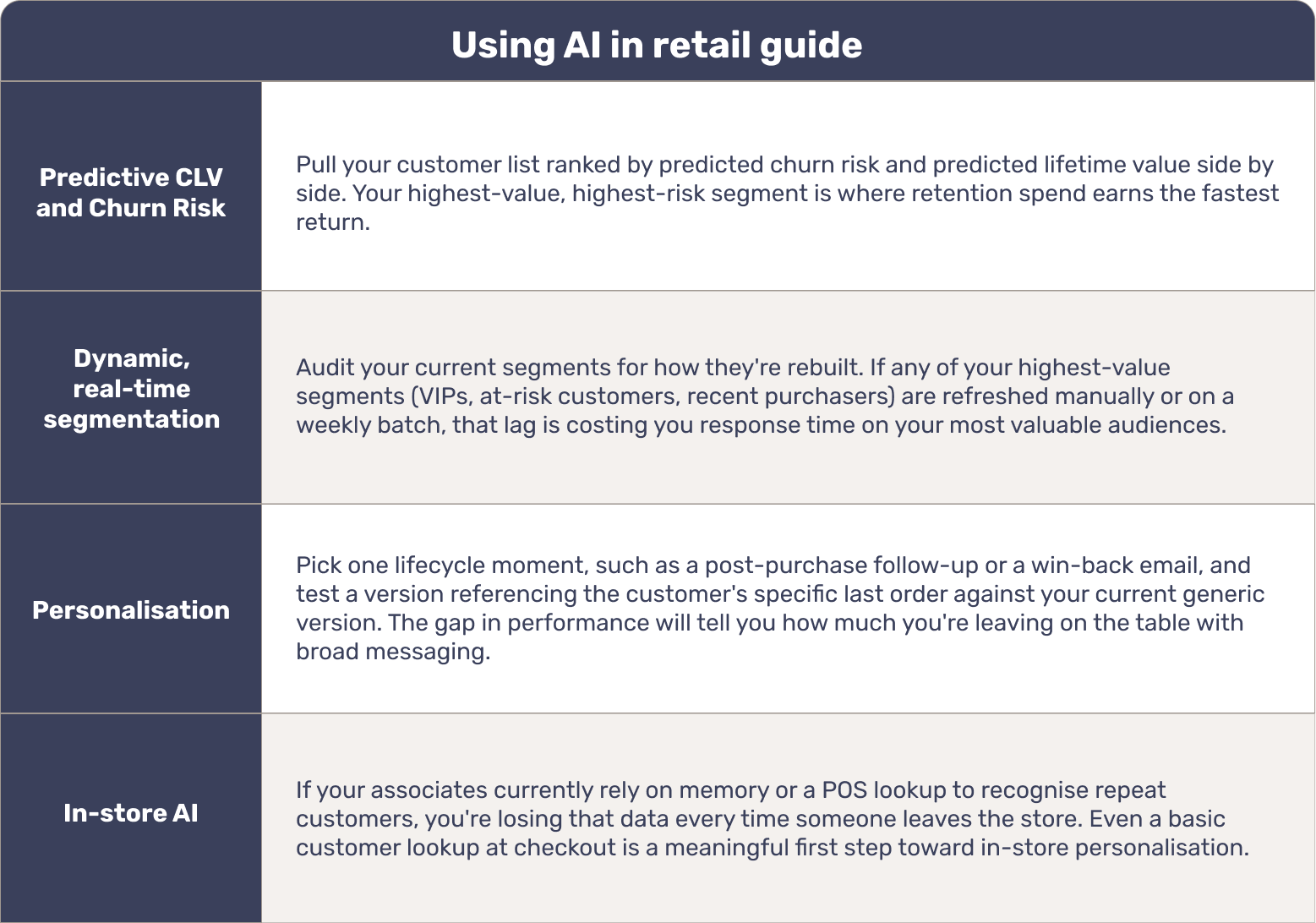
AI-powered scoring assigns every customer a set of forward-looking numbers, including predicted lifetime value, churn probability, and likelihood to buy again in a specific category. A churn model built on machine learning analyses a customer's purchase frequency, category behaviour, and engagement history to calculate their individual probability of lapsing, rather than applying one flat rule to the whole database.
Traditional RFM segmentation groups customers by what they've already done: how recently, how often, how much. Predictive scoring adds a forward-looking layer on top. A customer who bought once six months ago might score low on RFM but high on predicted lifetime value if their early purchase pattern matches your best customers at the same stage of the relationship. Retail businesses using AI-powered predictive analytics for churn prevention see materially better retention outcomes than those relying on reactive win-back rules alone, because they can act before the warning signs are obvious rather than after.
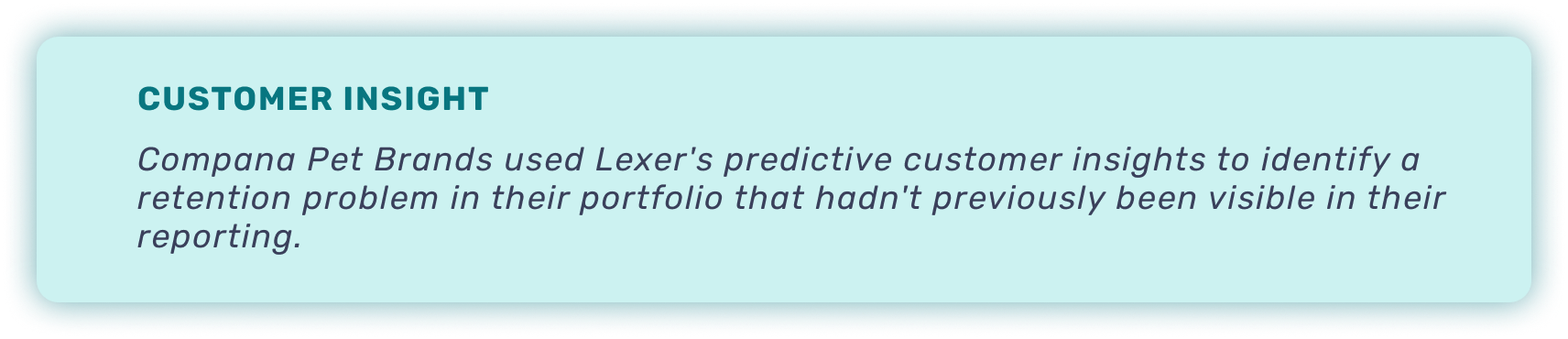
Compana Pet Brands used Lexer's predictive customer insights to identify a retention problem in their portfolio that hadn't previously been visible in their reporting. After acting on it, Bullymake achieved 14% year-on-year customer lifetime value growth and Dinovite cut its ratio of one-time buyers by 22%, as detailed in the Compana Pet Brands case study. For a deeper look at how the scoring itself works, see Lexer's guide to predictive retention signals.
2. Dynamic, real-time segmentation
AI-driven segmentation updates customer groupings automatically as new behaviour comes in, instead of relying on a marketer to rebuild static lists on a schedule. A segment built on a rule like "purchased in the last 90 days" is only accurate on the day someone builds it. A dynamically maintained segment recalculates continuously, so a customer moves in or out the moment their behaviour changes.
This matters most for time-sensitive triggers: a customer entering their typical repurchase window, a VIP whose spend has just dropped off, a browser who viewed a product three times without buying. Static segmentation catches these patterns days or weeks late, if at all. A customer segmentation platform built to update in real time catches them the day they happen, which is the difference between a relevant message and a stale one.
3. Personalisation at the individual level
AI-generated messaging tailors content to each customer individually, referencing their specific purchase history, loyalty status, and predicted preferences, rather than segmenting the whole list into a handful of static groups. According to Gartner's 2026 CMO Spend Survey, marketing organisations now allocate an average of 15.3% of their budgets to AI initiatives, yet only 30% report the maturity to actually scale that investment, which tells you the gap here is less about willingness to invest and more about data readiness.
The mechanics matter more than the marketing term. A genuinely personalised message references something specific: a recent order, a loyalty milestone, a product that complements what a customer already owns. A discount code blasted to the full list is not personalisation no matter how the platform describes it. Lexer's AI messaging tool, Contact, uses this kind of customer context to draft on-brand 1:1 messages at a volume a marketing team could never produce by hand, with a person reviewing and sending each one.
4. In-store AI: clienteling and associate tools
In-store AI tools give sales associates real-time customer context at the point of interaction, turning a store visit into data the same way an online session already is. Without this, most retailers lose the entire in-store conversation the moment a customer leaves. A sales associate has no record of what a customer asked about last visit, what they bought previously, or whether they're a first-time shopper or a loyal regular.
Clienteling tools close that gap by surfacing a customer's full profile, purchase history, and preferences to the associate on a tablet or device, and by capturing what happens during the visit back into the customer record. THE UPSIDE deployed Lexer's clienteling tool across three flagship stores and saw customers engaged through the tool convert at a 13% higher average order value, as documented in the case study. The tool also revealed that 71% of store visitors were new customers, a fact the brand had no visibility into before.
%20(1).png)
5. The data foundation AI actually requires
AI in retail marketing only produces good output when it's trained on a single, continuously updated customer profile that spans every channel a customer touches. An AI model built on ecommerce data alone cannot generate an accurate churn score for a customer base where a large share of purchases happen in-store. Garbage in, garbage out applies here more than almost anywhere else in marketing technology.
This is the part vendors tend to skip in the pitch. The AI tools are widely available now. The willingness to invest is there, per the Gartner figures above. What's frequently missing is the groundwork: identity resolution across channels, clean and de-duplicated records, and engagement data that updates in real time rather than on a nightly batch. A customer data and analytics platform that resolves identity across ecommerce, POS, loyalty, and email first is what makes every capability described above actually work in practice, rather than looking impressive in a demo and disappointing once it's live. For more on how retailers should think about the broader data layer this depends on, see Lexer's guide to the impact of big data analytics in retail.
%20(1).png)
6. Lexi: a natural language AI agent for retail teams
Lexi is Lexer's AI growth agent, a chat interface that lets a retail marketer ask a plain-language question and get an answer built from their own unified customer and product data, rather than waiting on an analyst or building a report from scratch. A marketer can ask which VIP customers have gone quiet, and Lexi returns the answer along with a segment ready to activate in the same conversation.
The underlying mechanic is what separates this from a standard chatbot bolted onto a dashboard. Lexi sits directly on top of the same unified customer record described above, so it can build segments, generate reports, and push audiences to connected channels such as email or paid media from a single request. It also shows its working: every answer includes the data it looked at and the reasoning behind the result, so a marketer can check the output before acting on it rather than treating it as a black box.
Data governance is built into how this works rather than bolted on afterwards. Lexi runs inside Lexer's secure AWS environment, does not send customer PII to external models, and operates within a brand's existing privacy and consent settings, which matters for any retailer weighing up AI tools against compliance requirements.
Practical application: Test Lexi on a task your team currently does manually, such as pulling a list of customers who browsed a category without buying, and compare the time it takes against your current reporting process. The gap usually shows up immediately for lean marketing teams without a dedicated analyst.
.png)
Where this leaves your marketing team
AI in retail marketing isn't a single tool you switch on. It's a set of specific, practical capabilities, predictive scoring, dynamic segmentation, individual personalisation, in-store context, and a natural language agent that ties them together, sitting on top of customer data that has to be unified before any of them work well. The retailers seeing real returns aren't the ones with the newest AI feature. They're the ones who fixed their data foundation first and are now applying prediction, personalisation, and conversational tools on top of it.
If your team is still working from static segments and manual customer lookups, start with the data layer before adding another AI-branded tool to the stack. Book a demo to see how Lexer's customer data platform turns unified retail data into the predictive scoring, segmentation, and personalisation described above.
Frequently asked questions
How is AI used in retail?
AI is used in retail marketing to predict customer behaviour (churn risk, lifetime value, next purchase), build segments that update automatically as behaviour changes, generate personalised messages at scale, and give in-store staff real-time customer context. Every one of these applications depends on clean, unified customer data as the input.
What is the role of AI in retail marketing?
AI's role in retail marketing is to turn raw customer data into forward-looking predictions and personalised actions that a team couldn't produce manually. Instead of segmenting customers by what they did last month, AI models predict what a customer is likely to do next, so marketers can prioritise outreach by commercial impact rather than recency alone.
What is the difference between AI and automation in retail?
Automation executes a fixed rule, such as sending an email three days after a cart abandonment, the same way every time. AI makes a prediction or judgement based on patterns in data, such as calculating a customer's individual churn probability, and that output changes as new data comes in. Many retail tools combine both: AI generates the insight, automation acts on it.