
March 25, 2026
|
6
minute read
The 5-step CDP implementation checklist for retail




Skipping foundational steps during CDP implementation is the fastest route to an expensive platform nobody uses. Here's a five-step checklist that keeps your retail CDP implementation focused on outcomes from day one.
Retailers are investing in CDPs at record pace. The market is projected to reach over $14 billion by 2030, according to Mordor Intelligence, with retail and ecommerce leading adoption. But spending doesn't equal results.
The CDP Institute reports that the biggest obstacles to successful deployment are organisational: cooperation between teams, adoption by users, and budget alignment.
The retailers who get strong ROI from their CDP share a pattern: they treat implementation as a business project with clear milestones, starting with defined use cases and ending with measurable outcomes. This checklist captures the five steps that separate successful CDP implementations from expensive shelf-ware.
1. Define your CDP implementation use cases before you touch the data
The most common implementation mistake is starting with data. Teams spend weeks connecting every available source, building a comprehensive single customer view, and then asking: "Now what?"
Flip the order. Start with the business questions your teams can't currently answer. These become your use cases, and they drive every decision that follows: which data sources to connect first, which integrations to prioritise, and how to measure success.
Strong use cases are specific and measurable. "Understand our customers better" is a goal, not a use case. "Identify high-value customers at risk of churning so we can trigger a re-engagement campaign within 7 days" is a use case. "Build suppression audiences to exclude recent purchasers from paid acquisition campaigns" is a use case.
Run a 90-minute workshop with stakeholders from marketing, ecommerce, customer service, and retail operations. Have each team name the top two customer questions they can't answer today. Rank those questions by potential revenue impact and feasibility. Your top three to five become the CDP implementation roadmap.
The actionable step: Write your use cases down in a shared document and circulate them before kickoff. Every implementation decision, which data to connect, which tools to integrate, which dashboards to build, should trace back to one of these use cases. If it doesn't serve a use case, it's not a priority for go-live. Lexer's customer success team facilitates this use case definition process as part of onboarding, ensuring the retail customer data platform is configured around your business outcomes.
2. Audit your data sources for quality as part of CDP implementation
Most retailers have between five and fifteen systems that hold customer data: ecommerce platform, POS, ESP, loyalty program, customer service software, website analytics, and more. The temptation is to connect everything at once. Resist it.
Start by listing every data source and answering three questions for each: What percentage of records have a usable email address? What percentage have a name? Are there known duplicate or conflicting records? This audit takes a day, not a month, and it tells you which sources will produce clean, matchable profiles and which ones need cleanup before they're useful.
Identity resolution, the process of matching records from different systems to the same real person, is only as good as the identifiers it has to work with. If your POS system captures email for only 30% of transactions, that's a gap you need to know about before you start expecting unified profiles for every customer.
Prioritise connecting the three to four sources that cover your core use cases first. You can add more later. A CDP with clean data from three sources beats a CDP with messy data from twelve.
The actionable step: Create a simple spreadsheet with columns for each data source, the key identifiers it captures (email, phone, name, loyalty ID), the approximate completeness of those fields, and the known data quality issues. Share this with your CDP vendor before implementation begins. Lexer's identity resolution platform handles matching across sources with imperfect data, and the onboarding team works with you to flag quality issues early so they don't compound post-launch.
3. Configure your CDP integration stack for bidirectional data flow
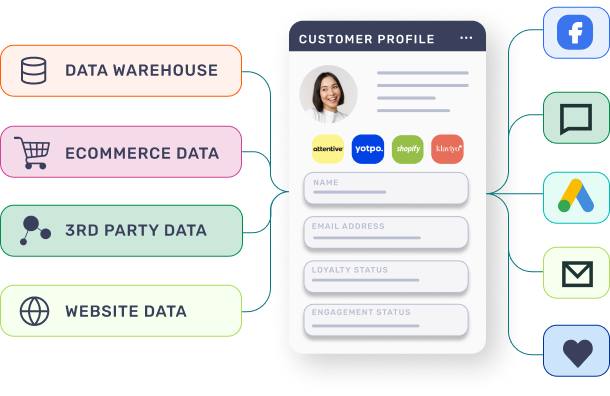
Connecting data into the CDP is half the job. The other half, and the one teams most often underestimate, is getting enriched data back out to the tools where your teams actually work.
If your marketing team builds a high-value customer segment in the CDP but has to manually export a CSV and upload it to Facebook Ads Manager every time they want to run a campaign, you haven't saved time. You've added a step. The same applies to your ESP, your SMS platform, your customer service software, and your in-store systems.
Bidirectional integrations matter because they close the loop. Data flows in from your sources, the CDP unifies and enriches it, and enriched segments flow back out to your activation channels automatically. This means audiences stay current, suppression lists update in real time, and your teams work from a single source of truth without manual handoffs.
During implementation, map every tool in your stack that either sends data to or receives data from the CDP. For each one, confirm: Is there a pre-built integration? Does it support bidirectional sync? What's the sync frequency (real-time, hourly, daily)? What happens when the integration breaks, is there alerting and error handling?
The actionable step: Make a list of every tool your teams use daily that touches customer data. Prioritise integrations for the tools that directly support your launch use cases from step one. Everything else can wait for phase two. Lexer's native integration platform covers the most common retail systems, and the onboarding team handles configuration so you're not bottlenecked by internal IT resources.
4. Build role-specific CDP training tracks for your retail teams
The fastest way to kill a CDP implementation is to train one person and hope they'll teach everyone else. That person becomes a bottleneck, and when they go on leave or change roles, usage drops to zero.
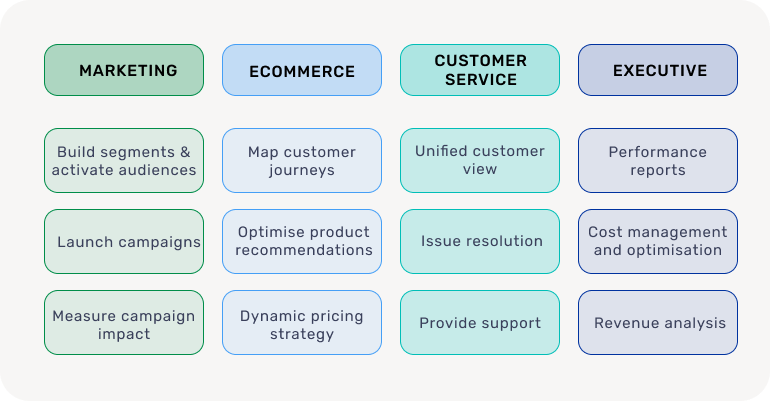
Different teams use a CDP differently. Marketing needs to build segments, activate audiences across channels, and measure campaign impact. Customer service needs to pull up a customer profile during a call or ticket and see the full relationship history. Retail store teams need next-best-action recommendations for the customers in front of them. The executive team needs dashboards that track customer health metrics over time.
A single two-hour training session that walks through every feature won't serve any of these groups well. Instead, build focused training tracks for each team that cover only what they need to do their job, with hands-on exercises using your actual data.
Set a minimum adoption threshold: at least three people in each team should be able to use the platform independently by the time you go live. This eliminates single points of failure and builds internal momentum as people start seeing value from the data.
The actionable step: Schedule separate 60-minute training sessions for each team in the first two weeks after go-live. Have each session focus on one use case relevant to that team, and end with a hands-on exercise where participants complete a real task in the platform. See how Harris Scarfe built persona-driven strategies with Lexer by getting buy-in across their team through practical, role-relevant training.
5. Set measurable CDP implementation success criteria and review quarterly
You can't hold a CDP accountable if you haven't defined what success looks like. Vague goals like "better data" or "improved customer understanding" aren't measurable.
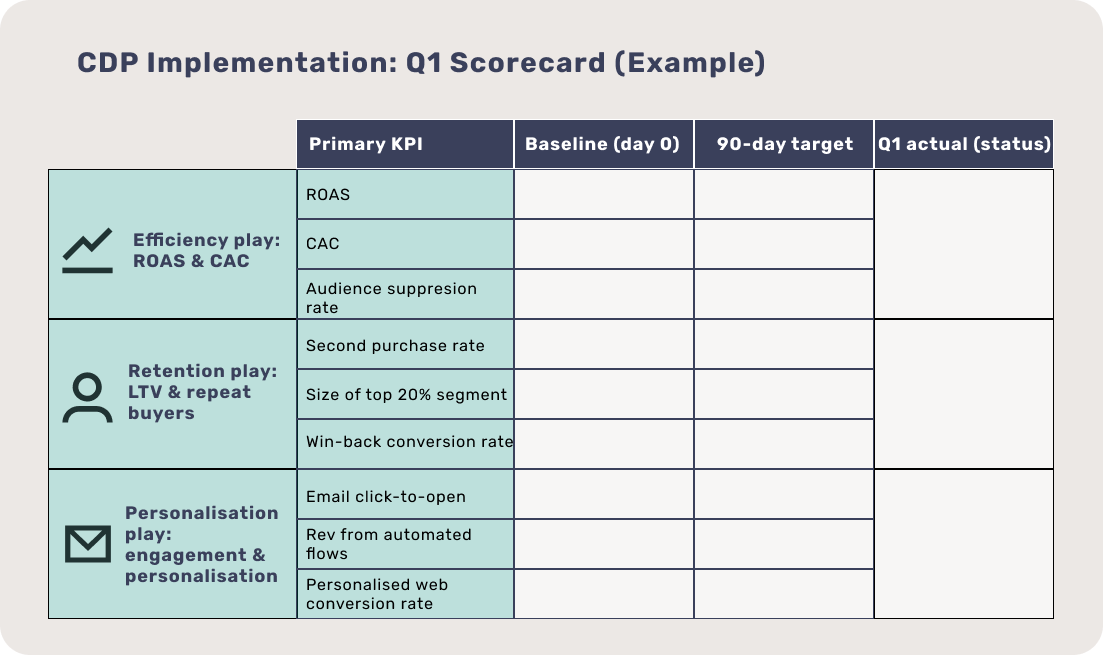
Before launch, define two to three KPIs tied directly to your use cases from step one. If your priority use case is reducing wasteful ad spend through audience suppression, measure cost-per-acquisition and ROAS before and after. If your priority is identifying and growing high-value customers, track the size and spend of your top-20% segment over time. If your priority is reducing churn, measure the retention rate of at-risk customers who received re-engagement campaigns versus those who didn't.
These metrics should be reviewed monthly by the team and quarterly with your CDP vendor. The quarterly review is where you assess whether the platform is delivering against your business case and adjust your strategy if it isn't. Without this cadence, it's easy for the project to drift.
The best CDP implementations evolve over time. Your first 90 days should nail the foundational use cases. Months three to six should expand to secondary use cases and additional data sources. Months six to twelve should introduce more advanced capabilities like predictive analytics and automated journeys. But each phase should have its own success criteria.
The actionable step: Create a one-page scorecard with your two to three primary KPIs, their baseline values, and your 90-day targets. Review it monthly. At the quarterly business review, bring this scorecard to the table and have an honest conversation about what's working and what isn't. Lexer's customer success team ties their own KPIs to your business outcomes, which means quarterly reviews are built into the engagement and focused on results.
Your CDP implementation checklist starts with outcomes, not data
Most retail CDP implementations that stall do so because teams skip the foundational work: use case definition, data auditing, integration planning, training, and measurement.
This checklist requires discipline: do the thinking before the doing, involve the right people early, and hold yourself accountable to measurable outcomes from day one.
Get these five steps right and the CDP becomes the operating system for your customer strategy.
Book a demo to see how Lexer's CDP implementation and customer success approach is designed to get each of these steps right from the start.