
June 25, 2026
|
6
minute read
What is the customer journey in retail? A CDP-powered guide




The retail customer journey is talked about constantly and understood poorly. Most retailers can describe it in theory. Far fewer can see it in their data. This guide explains what the customer journey actually looks like as a sequence of behaviours, where it breaks without unified data, and how a CDP makes every stage visible and actionable.
What is the customer journey in retail?
The retail customer journey is the complete sequence of interactions a customer has with your brand, from first awareness through to repeat purchase and advocacy. It spans multiple channels, occurs over varying timeframes depending on category and price point, and rarely follows a straight line. According to research based on a survey of 46,000 retail shoppers, cited by UniformMarket, 73% of retail customers use multiple channels during their shopping journey, engaging an average of six touchpoints before making a purchase.
The challenge for most retailers is being able to see the journey in their data. Each channel captures a fragment of the journey, but no single system assembles those fragments into a complete picture for each customer. A retail customer data platform does exactly that: it ingests data from every channel, unifies it into a single customer profile, and makes the complete journey visible for the first time.

Awareness: the first data signal most retailers miss
The awareness stage begins when a customer first encounters your brand, whether through a paid ad, an organic search, a social post, or a word-of-mouth recommendation from someone in their network.
Most retailers track awareness at the aggregate level, measuring impressions, reach, and traffic. What they rarely track is which awareness touchpoint is associated with which customer, because at this stage, the customer has not yet identified themselves. They are a browser, not a named profile.
The data gap here is significant. First-party data capture at the awareness stage, via email capture, loyalty programme sign-up, or a social login, creates a named customer record from the first interaction. Without it, everything that happens before the first purchase is invisible in your CRM. You know how many people visited your site; you do not know which of your eventual best customers entered through an organic search versus a paid campaign.
2. Consideration: where behavioural data becomes commercially valuable
The consideration stage is where the customer evaluates your brand and its products. They are browsing, comparing, reading reviews, and returning to product pages. This stage can last days or weeks depending on price point and category.
Behavioural data from the consideration stage is some of the most commercially valuable data a retailer holds. Browse history, category affinity, time spent on specific product pages, and wishlist additions all reveal purchase intent before a transaction occurs. A customer who visits a specific product page three times over a two-week period is signalling something that a generic email sequence is not designed to respond to.
A customer analytics platform that captures and connects browse behaviour to customer profiles enables the consideration stage to become an active targeting surface. The same customer who is browsing and comparing can receive a prompt, a notification of low stock, a user review highlight, or a personalised recommendation that accelerates their decision.
3. Purchase: the transaction that opens the retention window
The purchase event is the most tracked moment in the retail customer journey and, in isolation, the least useful for retention. What matters commercially is not the purchase itself but what you do with the data it generates.
A first purchase opens the retention window. According to data from Smile.io, based on a sample of over 1.1 billion shoppers across 250,000 ecommerce brands, a customer who has made one purchase has a 27% chance of returning for a second. Get them to a second purchase and that probability rises to 49%. A third purchase takes it to 62%.
The first purchase also produces the most valuable data you will ever have about a customer: their first-category signal. The first product a customer buys tells you something about their preferences, price sensitivity, and likely repurchase window that no acquisition-stage data can approximate.

4. Retention: the stage that determines profitability
The retention stage begins immediately after the first purchase and extends for as long as the customer continues to buy from you. It is where lifetime value is built or lost.
Research by Frederick Reichheld of Bain & Company, cited in Harvard Business Review, shows that a 5% improvement in customer retention rates produces a 25 to 95% increase in profits. The range is wide because it depends on category, margin structure, and starting retention rate, but the direction is consistent: even modest improvements in retention produce outsized profitability gains.
The retention challenge for most retailers is that they manage it reactively. Win-back campaigns trigger when a customer has already lapsed. Reactivation discounts go to customers who have already moved on. The data that would allow proactive intervention, a change in purchase cadence, a drop in category engagement, a shift from in-store to online that typically precedes lapsing, is available in unified customer profiles but not visible in the fragmented systems most retailers use.

5. Advocacy: the stage most retailers forget to design for
The advocacy stage is where satisfied customers recommend your brand to others, write reviews, share purchases on social media, and refer friends. It is also the stage retailers most consistently fail to design for, because it is not tied to a purchase event and therefore does not appear naturally in transaction-focused data systems.
Advocacy is valuable because referred customers have a higher lifetime value and a higher first-to-second purchase conversion rate than customers acquired through paid channels. They arrived with a positive prior, already partial to your brand from someone they trust.
The data infrastructure for advocacy is the same as for retention: a unified customer profile that includes loyalty programme participation, review history, referral programme activity, and social engagement, all linked to purchase behaviour. CALECIM® used Lexer's unified customer data to identify their most engaged segment, build targeted communication sequences, and achieve a 31% increase in repeat sales. The customers most likely to become advocates are identifiable from their behaviour patterns before they have made a referral.

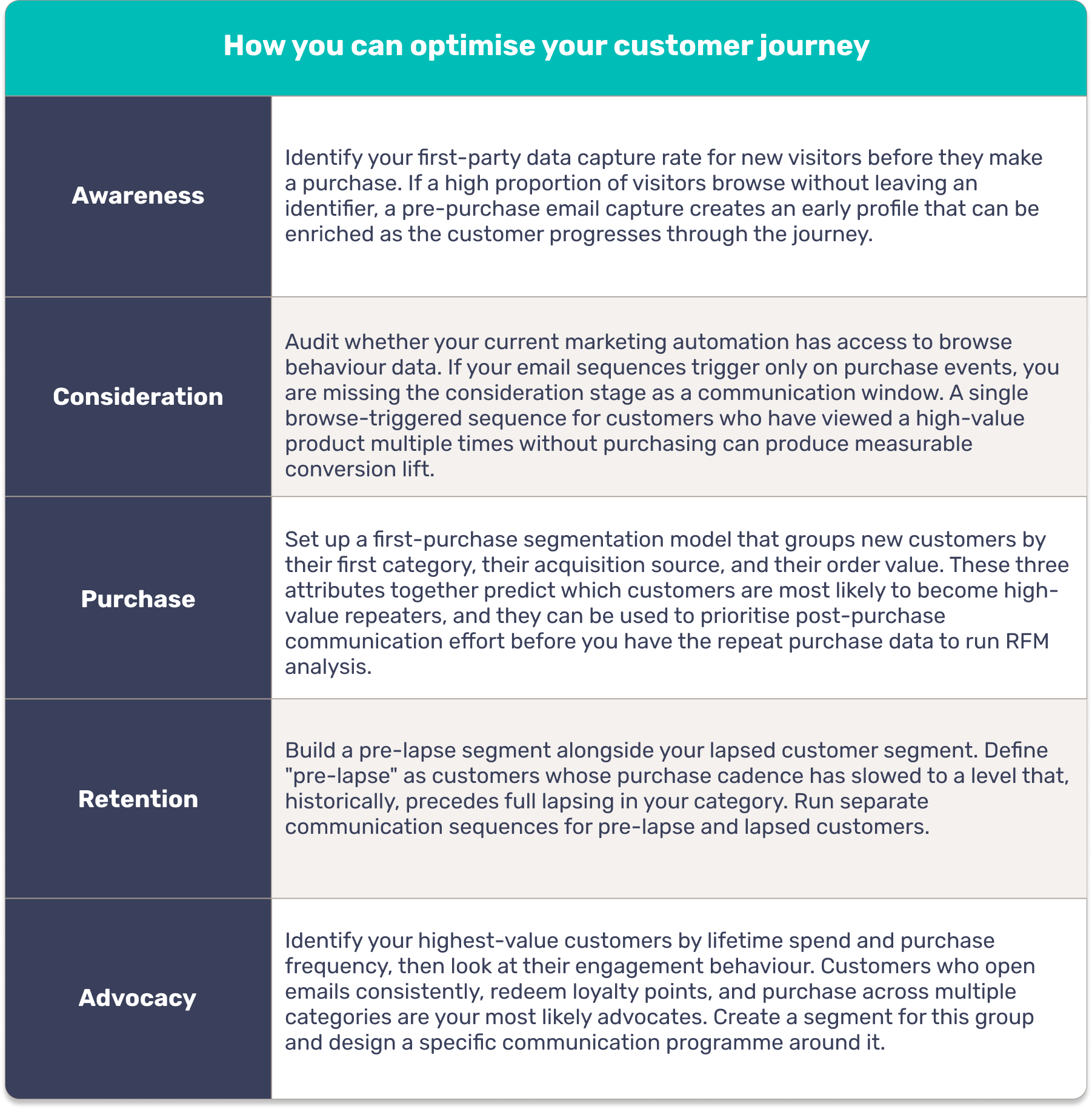
How you can optimise your customer journey
See your customer journey in your data
Understanding the retail customer journey conceptually is straightforward. Seeing it in your actual customer data requires the right infrastructure.
A customer data platform for retail connects every channel you operate, resolves customer identities across those channels, and gives you a complete view of each customer's journey from first touch to most recent purchase. The journey insights you cannot currently see are already in your data. They just need to be assembled.
Book a demo to see what your customer journey looks like in Lexer.
FAQs
How does a CDP improve the customer journey?
A customer data platform improves the retail customer journey by unifying data from every channel into a single customer profile, making the complete journey visible for the first time. This enables retailers to communicate with customers based on their actual behaviour across all touchpoints, rather than the partial view available in any single system. The result is more accurate segmentation, more relevant personalisation, and better-timed interventions at every journey stage.
What does the retail customer journey look like?
The retail customer journey typically moves through five stages: awareness (first contact with the brand), consideration (evaluation of products and options), purchase (first and subsequent transactions), retention (ongoing engagement and repeat buying), and advocacy (recommendation and referral). In practice, the journey is non-linear, with customers cycling between stages and using multiple channels at each. Omnichannel shoppers interact with an average of six touchpoints before making a purchase.
What is a customer journey map in retail?
A customer journey map in retail is a visual representation of the stages, touchpoints, and behaviours a customer goes through from first awareness to repeat purchase. It is used to identify where customers drop off, where they are most responsive to communication, and which channels are most commercially significant at each stage. A data-driven journey map is built from actual customer behaviour data rather than assumed sequences.