
GUIDES
What is retail analytics software?
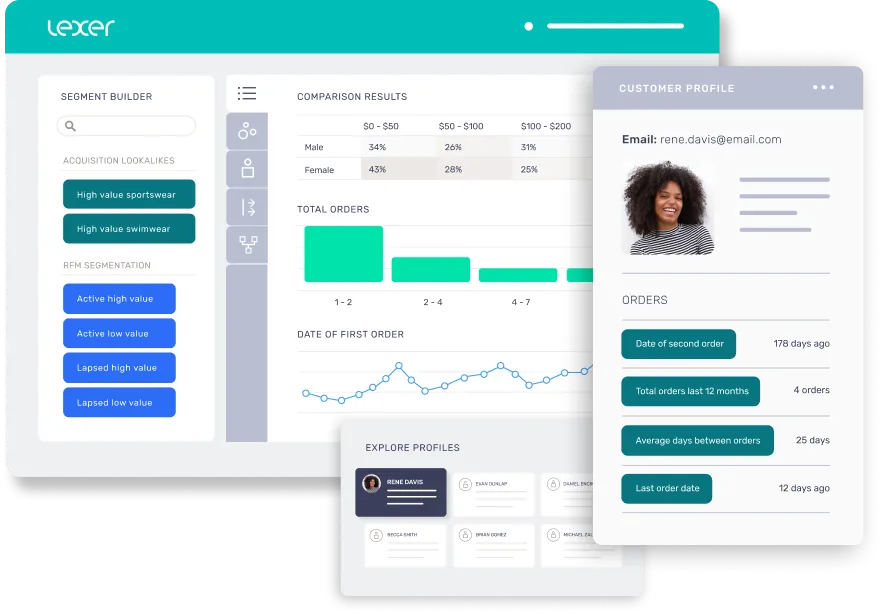
Retail analytics software turns operational and customer data into information a retailer can act on, covering sales performance, inventory movement, customer behaviour, store operations and marketing return. The label stretches across at least six distinct product types, and the gap between them is wide enough that choosing the wrong category costs more than choosing the wrong vendor within it.
Almost every retailer buying in this space already owns something that partially does the job, which is worth establishing before anyone looks at a shortlist.
The six categories
Merchandise and inventory analytics are often built into an enterprise resource planning system, answers questions about what sold, where, and what should be ordered next. This is the oldest and most mature part of the market, and for many retailers it's the part that already works.
Store operations analytics covers footfall, conversion, staffing and dwell time, usually drawing on sensors or point of sale (POS) data. Useful for a store estate of any size, and largely blind to the individual customer.
Ecommerce and web analytics tools track sessions, funnels and on-site behaviour in detail. They see the visit rather than the person, which matters more than it sounds once someone browses on a phone and buys in a shop.
Marketing and attribution tools connect spend to revenue. They're pixel-based, so they'll tell you which advertisement drove a sale and not whether that sale protected or destroyed margin.
Business intelligence platforms will visualise anything you model into them. Enormously flexible and entirely dependent on having people to do the modelling, which makes them excellent in organisations with a data team and frustrating in organisations without one.
Customer analytics and customer data platforms come at it from the person rather than the transaction, resolving identity across channels first and analysing afterwards. Narrower in scope than business intelligence and considerably faster to an answer about a customer.
What they all struggle with
Two problems cut across every category above, and neither is fixed by buying better software within a category.
Customer identity is the first. Almost all of these products analyse events rather than people, so the same shopper appearing as three records produces three sets of behaviour, none of them accurate. Sales analytics can tolerate this because it counts transactions. Customer analytics can't, and any conclusion drawn about loyalty, retention or value from unresolved data is wrong in ways that don't announce themselves.
Product cost is the second. It typically lives in the merchandising or enterprise resource planning system and rarely reaches anything marketing touches, which means most retail analytics runs on revenue. Revenue ranks a customer who spends four thousand dollars at forty per cent off above one who spends three thousand at full price, and no amount of dashboard design corrects that.
What retail-specific actually means
Almost every vendor in this market describes itself as built for retail, and the claim is worth interrogating because it's occasionally true and frequently decorative.
A genuinely retail-specific product understands a product hierarchy, meaning it knows that a size and a colourway roll up into a style and a style rolls into a category, and it can report at each level without someone building the mapping. It understands seasonality as a structural feature rather than as noise, so it doesn't flag every February as a collapse. It handles markdown and full price as distinct states, which matters enormously once margin enters the picture. And it knows that a return is a different event from a cancellation and that both behave differently again in store than online.
A product without those concepts can still be pointed at retail data, and someone on your team will spend their first two quarters teaching it what a season is. That work is real, it rarely appears in a business case, and it has to be redone whenever the person who did it leaves.
The quick test in a demo is to ask how the product handles a style sold across five sizes and three colours, where two of the colours were marked down in the third week. A retail product answers immediately. A general one starts describing a configuration exercise.
What it costs, and what actually costs more
Licence models vary too much to generalise usefully. Business intelligence tools are cheap per seat and expensive in the people needed to run them. Enterprise merchandise analytics is the reverse, with a large licence and a smaller operating burden. Customer data platforms sit somewhere between, and pricing usually scales with profile count.
The cost that catches retailers out is the analyst queue. A product that requires someone technical to answer every new question doesn't remove a bottleneck, it relocates one, and the relocated version is harder to staff. Before committing, it's worth counting how many of the questions your team asked last month needed a specialist, because that number is what you're actually trying to reduce.
Testing a product properly
Write down the ten questions your team asked the data team last month, before you see a single demo. Give three of them to each vendor and ask for live answers, on your own data if the sales process allows it.
Then check three specific things. Look up a customer who has bought online and in store, and count how much of their history appears. Ask where the margin figure comes from and follow it back to a source. Have a non-technical colleague drive part of the session unassisted, which is the closest you'll get to seeing what month three looks like.
Where Lexi fits
Lexi sits in the last of those six categories, and the reason it belongs in a comparison like this one is that it addresses both of the cross-cutting problems rather than working around them.
Lexi ingests transactions, inventory, POS, loyalty, reviews and signals, resolves identity across every touchpoint, and holds product cost alongside the order, so gross margin per customer and discount dependency are available rather than theoretical. A semantic layer carries what your terms mean in your business, which is why the answers come back in retail language rather than in generic analytics language.
Then anyone can ask. You put a question in plain language, Lexi builds the answer from the data and shows the calculation behind it, then builds the segment and pushes it to the tools your team already runs. An analyst at a jewellery brand once spent a week assembling the data for a quarterly board report; Lexi answered the same questions in under a minute.
Lexi runs inside AWS Bedrock, data never leaves the platform, no personally identifiable information enters AI processing, and Lexer is SOC 2 certified.
Choosing between the categories
If the pressing question is about stock, buy merchandise analytics. If it's about store performance, buy store operations analytics. If it's about which advertisement worked, buy attribution. If you have a data team and a broad set of unpredictable questions, business intelligence will serve you well.
If the question is about customers, and particularly if it involves who's worth what and who's about to leave, none of the first four will answer it and business intelligence will only answer it after someone builds the model. That's the gap customer analytics exists to fill.
Related Articles
📄 Customer Data Platform (CDP)
📄 Customer Intelligence Platform
📄 Customer Data Platform Architecture
📄 Customer Segmentation in Retail
📄 Customer Experience in Retail